Modern Slavery Act Statement
HUMAN RIGHTS AND MODERN SLAVERY TRANSPARENCY STATEMENT 2025
Thermo Fisher Scientific Inc.’s (“Thermo Fisher”, “we” or the “Company”) 4i Values of Integrity, Intensity, Innovation and Involvement are the foundation of our culture and fundamental to our growth. As the first of these values, Integrity reminds our colleagues to honor commitments, communicate openly and demonstrate the highest ethical standards. This includes a commitment to ensuring that our own operations and our supply chain respect human rights and fair labor practices, and uphold global standards for equal opportunities, the freedom to associate, as well as the elimination of modern slavery, human trafficking, and harmful or exploitative forms of child labor.
This statement is made pursuant to:
- the California Transparency in Supply Chains Act (“California Act”);
- section 54(1) of the UK Modern Slavery Act (“UK Act”);
- the reporting requirements under the Commonwealth of Australia Modern Slavery Act (“Australian Act”);
- the Norwegian Transparency Act (“Norwegian Act”);
- the Swiss Ordinance on Due Diligence and Transparency in relation to Minerals and Metals from Conflict-Affected Areas and Child Labor (“VSoTr”)1; and
- the Canadian Fighting Against Forced Labor and Child Labor in Supply Chains Act (“Canadian Act” and, collectively, the “Acts”).
This statement constitutes our human rights and modern slavery transparency statement for the financial year ending December 31, 2025 and was approved by the Thermo Fisher Board of Directors on May 20, 2026. Our previous human rights and modern slavery statements are available in the Reporting Hub within the “Corporate Social Responsibility” section of our website, which can be found here.
The information in this report excludes the operations and supply chain of our recently acquired filtration and separation business, acquired on September 2, 2025, and Clario, acquired on March 24, 2026. Accordingly, the due diligence measures described in this report do not cover those newly acquired entities.
1. Organization Structure, Operations and Supply Chains
Thermo Fisher, as parent company of the Thermo Fisher group of companies (the “Group”),
issues this statement on behalf of itself and each of its subsidiaries that are subject to each of the Acts, respectively, and in particular, its subsidiaries listed in Annexes I to V (the “Reporting Subsidiaries”), which have conferred and collaborated in the preparation, review and finalization of this statement.
Thermo Fisher is the world leader in serving science. Our Mission is to enable our customers to make the world healthier, cleaner and safer. We serve customers working in pharmaceutical and biotech companies, hospitals and clinical diagnostic labs, universities, research institutions and government agencies, as well as environmental, industrial, research and development, quality and process control settings. Our global team delivers an unrivaled combination of innovative technologies, purchasing convenience and pharmaceutical services through our industry-leading brands, including Thermo Scientific, Applied Biosystems, Invitrogen, Gibco, Fisher Scientific, Unity Lab Services, Patheon, and PPD.
We report our business in four segments - Life Sciences Solutions, Analytical Instruments, Specialty Diagnostics, and Laboratory Products and Biopharma Services.
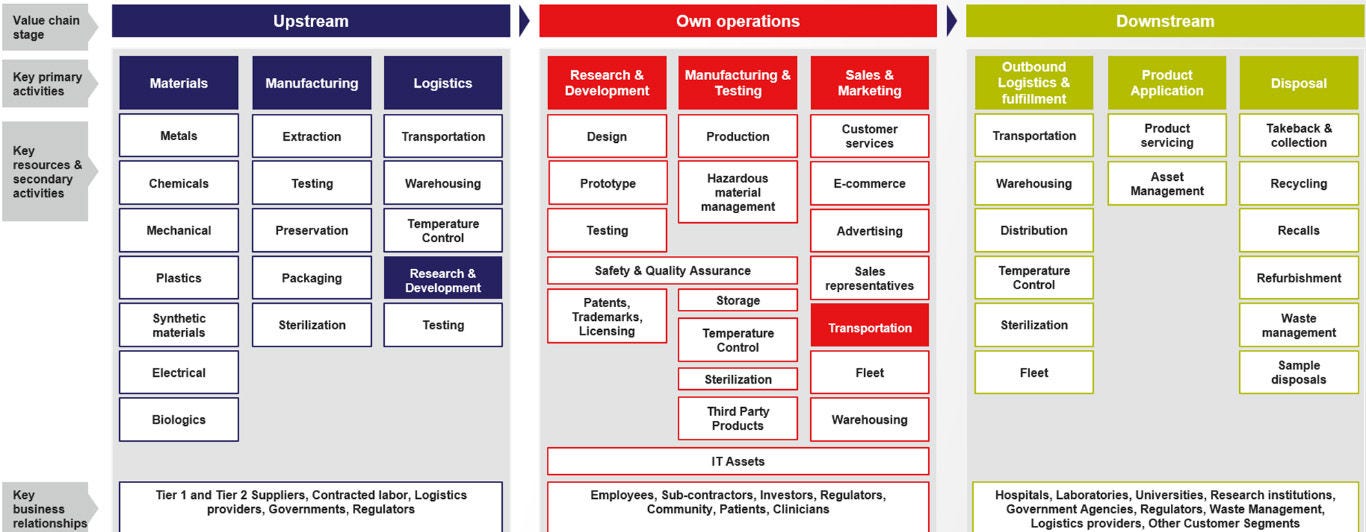
Our value chain consists of three stages: Upstream, Own Operations & Downstream. This value chain is summarized below:
We are committed to maintaining the strongest team in our industry, focusing on developing and retaining our colleagues, while leveraging our Mission and leadership brand to attract new colleagues to our Company. As of December 31, 2025, we employed approximately 125,000 colleagues globally, with an approximate regional distribution as follows: 59,000 based in the Americas, 22,000 in the Asia-Pacific region, and 44,000 in Europe, the Middle East and Africa (“EMEA”).
For more information regarding our business, please see the “Business” section of our Annual Report on Form 10-K for the year ended December 31, 2025, which can be found here.
1.1 Corporate Structure and Governance
As the world leader in serving science, Corporate Social Responsibility (“CSR”) is an integral aspect of how we think about strategy and risk. Our Company leadership team ensures our CSR priorities are embedded in business decisions and operating practices, which we believe also strengthens our organizational culture to drive results and success. Strategic investments in technology, products, people and the planet help to ensure sustainable growth and enable us to deliver long-term value and strong returns for our shareholders. Our CSR strategy is informed by robust stakeholder engagement and is actively refreshed to identify value creation opportunities and minimize risk. Board-level governance is held within the Nominating and Corporate Governance Committee, which oversees the Company’s governance and CSR-related strategy, risks, opportunities and external reporting, and reports to the full Board as appropriate.
Current versions of the Company’s Corporate Governance Guidelines, Code of Business Conduct and Ethics, and charters for each of the Board Committees can be found at www.thermofisher.com.
In 2025, we continued operational oversight of our human rights management approach through our designated Global Human Rights Counsel. This person leads the coordination of our human rights program across all businesses and relevant functions, including Human Resources, Environmental Health and Safety, Procurement, Corporate Social Responsibility, and Corporate Communications.
Consistent with the UN Guiding Principles on Business and Human Rights, this structure supports the integration of human rights considerations into our governance, risk management, and due diligence processes. It also enhances awareness, promotes ongoing compliance, and reinforces adherence to our policies, standards, and applicable legal requirements.
The Global Human Rights Counsel provides regular updates to senior management on key human rights risks, program effectiveness, and continuous improvement initiatives.
1.2 Supply Chain Structure and Governance
Our supply chain includes approximately 60,000 direct and indirect suppliers globally. These suppliers provide the raw materials we use for manufacturing, services to support our research teams and the lab equipment, chemicals, and other vital goods used across our manufacturing and service network around the world. No single supplier is material, although for reasons of quality assurance, regulatory requirements, cost effectiveness, availability or uniqueness of design, certain materials and components may be sourced from a single supplier or a limited number of suppliers that can readily provide such materials or components.
Governance and management of our sourcing and buying teams is the responsibility of Global Procurement and reflects a matrixed structure of category management teams and divisional procurement teams. Both play critical roles in our procurement processes while working collaboratively to meet business needs and requirements.
Our Global Procurement team manages enterprise-wide spend through a category-structured taxonomy comprising 26 categories, with dedicated teams responsible for each area of focus. Global Procurement leads the development of category strategies, execution of strategic sourcing decisions, and ongoing supplier relationship management, while partnering with our supply base to drive innovation and value creation.
Global Procurement works closely with our Global Sustainability function to integrate sustainability considerations into procurement processes and sourcing decisions. This collaboration supports the identification and mitigation of supply chain risks, including those related to environmental and social factors, and contributes to supplier alignment with our business requirements, standards, and applicable compliance obligations.
More information about our supply chain is available in the “Corporate Social Responsibility” section of our website under the heading “Operations,” which can be found here.
2. Our Policies and Guidelines
As a signatory to the UN Global Compact (“UNGC”), Thermo Fisher is committed to aligning corporate strategy with the Ten Principles on human rights, labor, environment and anti-corruption and to the applicable laws and fair labor practices, as evidenced by the following Company policies:
- Human Rights and Equal Opportunity Policy
- Code of Business Conduct and Ethics
- Supplier Code of Conduct
- Responsible Minerals Sourcing Statement
These policies help us implement a human rights framework aligned with leading international standards, including the UN Universal Declaration of Human Rights and the International Labour Organization (“ILO”) Declaration on Fundamental Principles and Rights at Work. Our approach references the United Nations Guiding Principles on Business and Human Rights (“UNGP”) and the Organisation for Economic Co-operation and Development (“OECD”) Guidelines for Multinational Enterprises (“OECD Guidelines”).
When differences arise between our standards and legal requirements, we seek to apply the stricter standard.
With the rapid evolution of technology, society’s needs, and stakeholder expectations, we continue to strengthen our policies and business processes for identifying, assessing and managing human rights risks, including by conducting periodic internal reviews of our systems and controls and participating in human rights peer networks for best practice sharing.
Human Rights and Equal Opportunity Policy
The Thermo Fisher Human Rights and Equal Opportunity Policy (the “Human Rights Policy”) outlines principles and commitments for the Company’s operations, which include: the prohibition of forced labor, prison labor and trafficking in persons; prohibition of child labor; non-discrimination and equal opportunity; fair treatment; adequate wages, benefits and working hours; freedom of association; as well as healthy and safe work standards. It applies to all Thermo Fisher employees, contractors, agents, and other partners through whom Thermo Fisher conducts business.
Our Code of Business Conduct and Ethics
The Thermo Fisher Code of Business Conduct and Ethics (the “Code of Conduct”) is translated into 21 languages and covers a broad range of topics, including policies related to conflicts of interest, honest and ethical fair dealing, bribery and improper payments, insider trading, export control awareness, human rights, privacy matters, respectful interactions at work and harassment. It applies to all directors and colleagues of Thermo Fisher, as well as business partners, including consultants, contractors, distributors, agents and other representatives who act on behalf of our Company. It sets forth our commitment to conduct business with the highest ethical standards and to comply with all applicable laws and regulations. Violations may lead to disciplinary action, up to and including termination.
Supplier Code of Conduct
The Thermo Fisher Supplier Code of Conduct (“Supplier Code”) outlines expectations for our suppliers/partners and their subcontractors in the areas of ethics, human rights, health and safety, environmental responsibility, and management systems. In 2025, we reviewed our Supplier Code to maintain expectations associated with local laws and regulations. These expectations are in line with our corporate values, the Code of Conduct and the UNGC’s Ten Principles, and include:
- prohibitions on use of child labor, as described in Minimum Age Convention 138 and Worst Forms of Child Labor Convention 182 of the International Labor Organization;
- prohibitions on forced labor/prison labor, as described in Article 2 in the Forced Labor Convention 29 and Article 1 in the Abolition of Forced Labor Convention 105 of the International Labor Organization;
- requirement to comply with applicable labor laws, rules, and regulations, including but not limited to, all laws forbidding the solicitation, facilitation, or any other use of slavery, servitude, forced or compulsory labor or human trafficking;
- requirements for our suppliers to provide all information or material required to enable Thermo Fisher to ensure compliance with such laws, rules, and regulations; and
- commitments to responsible sourcing practices, including: (i) taking appropriate health and safety measures, (ii) acting in an environmentally responsible manner, (iii) commitments to non-discrimination and equal opportunity, and fair treatment.
The Supplier Code is also integrated into supply agreements and terms and conditions, and suppliers are expected to share their performance against Supplier Code expectations at our request. Under our Supplier Code, Thermo Fisher reserves the right to take appropriate contractual steps up to and including contract termination where necessary and appropriate as outlined in the Supplier Code.
Responsible Minerals Sourcing Statement
The Thermo Fisher Responsible Minerals Sourcing Statement outlines our commitment to the responsible sourcing of minerals used in our products. Our products use a variety of materials, including tantalum, tin, tungsten and gold. We are committed to sourcing materials from companies that share our values regarding human rights and environmental sustainability, and work with the Responsible Minerals Initiative to drive ethical sourcing of minerals. Our Responsible Minerals Sourcing Statement can be found here.
3. Stakeholder Engagement
We engage transparently and collaboratively with our stakeholders to help ensure the effectiveness of our human rights program.
In 2025, we continued to engage with a range of external stakeholders to maintain current knowledge, inform our risk-based due diligence, learn from emerging best practices, and contribute to the advancement of responsible business conduct. These engagements support our understanding of evolving human rights risks, regulatory expectations, and stakeholder priorities.
Our teams participate in a variety of external forums and initiatives, including:
- Industry groups: participation in initiatives, including the Responsible Minerals Initiative, to gain insights into emerging trends, regulatory developments, and impactful practices.
- Peer networking: engagement in initiatives such as the Sustainable Procurement Pledge and the UNGC network to exchange practical experience and identify best practices for potential incorporation into our programs.
- Non-government Organizations (“NGOs”): engagement with NGOs and investor groups, to better understand risks, critical trends and stakeholder expectations.
- Government consultations: review of guidance to stay informed on evolving legal requirements and policy expectations, and interactions to share knowledge and contribute to the development of effective global policies, including on the responsible use of technology and the protection of individual privacy rights
These engagements take place through various forums such as webinars, trade and industry shows, networking events or virtual and in-person meetings. Insights gained through these interactions, including stakeholder perspectives, are considered in the ongoing enhancement of our policies, due diligence processes, and public disclosures.
3.1 Worker Engagement
Thermo Fisher promotes worker voice through direct engagement across our operations and supply chain. Onsite visits and audits provide opportunities to observe working conditions and engage directly with workers.
As part of our supplier audit protocol, we conduct confidential worker interviews without management present, enabling workers to speak openly about their experiences. In 2025, we conducted 115 worker interviews across our supply chain. Findings are reviewed with leadership at least quarterly, and any critical issues are escalated in line with internal procedures.
In addition, workers can raise concerns at any time through established complaint mechanisms outlined in the following section.
4. Complaint Procedures – Global Ethics Hotline
We encourage reporting and offer a number of resources for the reporting of illegal or unethical behavior in our operations or in our supply chain, such as our confidential Global Ethics Hotline (“Ethics Hotline”). The Ethics Hotline is our telephone and web-based hotline maintained by a third party for the purpose of gathering information regarding compliance and ethics concerns. It is available to colleagues, customers and other external stakeholders such as suppliers and workers in the supply chain, to raise concerns, anonymously if requested, related to any issue, observed or suspected, including human rights issues, and violation of any law, regulation, or any Company policies.
In addition, and in line with our company’s value of Integrity, anyone can report human rights, ethics, and compliance-related concerns directly to any level of internal leadership, as well as to Legal or Human Resources representatives.
Reports of violations of law, or any Company policies are rigorously investigated and documented.
Our non-retaliation policy ensures that retaliation against any person who lawfully and in good faith seeks advice, raises a concern, reports misconduct, or provides information in an investigation is strictly prohibited and will not be tolerated.
The Supplier Code also prohibits any supplier’s unlawful retaliation against its employees, including the threat of reprisal, intimidation, or harassment, for reporting violations or cooperating in investigations.
5. Due Diligence, Risk Assessment and Management
We have developed processes and management systems to appropriately identify and assess adverse impacts, prevent or mitigate these impacts or provide for remediation when appropriate, and track implementation, as informed by the OECD Due Diligence Guidance for Responsible Business Conduct (“OECD Guidance”).
During the year, we continued to enhance our human rights due diligence practices under established human rights governance, including oversight by our Global Human Rights Counsel. This included in-depth human rights risk assessment of our operations and supplier network in compliance with regulatory requirements and internationally recognized standards. Our assessments indicate that human rights risks, including forced and child labor risks, in our operations in the aggregate remain low. This is primarily due to our company-wide applicable standards, and the preventive and mitigating measures that we have implemented in our standard processes, such as comprehensive policies, employee training, personnel documentation checks, use of working time management systems, and environmental, health and safety (“EHS”) site audits and certifications. A new internal oversight process enables the company to more regularly monitor human rights-related matters, and continue to identify, assess and manage human rights risks.
In 2025, we expanded our third-party due diligence assessments to our downstream value chain to include targeted questions and compliance certifications on labor and human rights topics for third-party intermediaries, including distributors. Based on the information available from our assessments to date, we have not identified any material human rights concerns. The vast majority of third-party intermediaries confirmed alignment with our values and principles, and where opportunities for improvement were identified, commitments were made to operate in accordance with our standards.
We source components globally that are used both at our facilities and by our external partners to manufacture our products. With such a global structure, the supply chain is the main area where Thermo Fisher is at the highest risk for adverse human rights impacts.
Thermo Fisher expects suppliers to treat their employees with dignity and respect, to comply with all legal and regulatory requirements pertaining to the fair treatment of employees, and to proactively assess and monitor their subcontractors to ensure they abide by the same principles. We are committed to implementing effective systems and controls to ensure that our suppliers recognize our position in relation to compliance with applicable laws and regulations.
Our risk-based approach to supplier engagement and monitoring allows us to focus our resources on areas that we believe have the largest potential impact. Our supply chain risk assessment starts with evaluating all suppliers based on geography and industry by risk ranking locations and industries where risks of labor, human rights, or environmental issues are generally highest. This risk assessment references external sustainability sources and indices including from WRI, WHO, UNDP, ILO, The World Bank and the Corruption Perception Index, as well as a large database of actual corporate performance on labor, human rights, and environmental topics. Globally, the percentage of our supply chain that falls into the highest risk portion of this assessment represents less than 1% of all suppliers.
Following this comprehensive process, we further seek to prioritize areas for direct supplier assessment. In 2025, we executed detailed supplier engagement initiatives focusing on suppliers who:
- demonstrated highest risk in the industry and geography specific assessment described above;
- provided products that are likely to contain minerals at risk of being sourced from conflict affected areas;
- performed insufficiently in earlier assessments or demonstrated some other type of residual risk; or
- were otherwise considered strategic for our businesses.
Human rights are integrated into our follow-on supplier due diligence process, where indicators such as the risk of child labor, the risk of modern slavery, the right of freedom of association, and the decency of working conditions are evaluated.
In 2025, Thermo Fisher utilized multiple mechanisms to conduct due diligence to evaluate and address modern slavery risks, such as third-party reviewed supplier assessments, including specific human rights assessments, and onsite auditing. These mechanisms allow us to monitor compliance with our Supplier Code and to assess and accelerate improvements in supplier practices.
Third-party assessments were conducted for the following targeted supplier populations:
- suppliers representing the top 71% of spend for the Fisher Scientific distribution channel;
- suppliers representing the top 75% of direct materials spend for our self-manufactured product portfolio; and
- suppliers who were identified as high-risk based on the risk assessment criteria described above.
Additionally, where suppliers who fall outside the targeted supplier populations voluntarily share the results of a supplier assessment completed for another customer, Thermo Fisher included such assessments in our program. For all assessments received in the previous two years (2024 and 2025), greater than 87% represented at least “good” management practice, and less than 1% were identified as having “insufficient” performance.
In all cases, where performance is deemed “insufficient” or “partial”, corrective action plans are requested from suppliers to drive continuous improvement. Thermo Fisher monitors these suppliers to confirm that the corrective action plans are implemented, and suppliers are reassessed in twelve months’ time. Suppliers who persistently refuse to participate or do not demonstrate continuous improvement are targeted for escalated engagement, potentially including a third-party, onsite audit.
Additionally, targeted supplier engagement was undertaken for additional investigation into due diligence activities associated with responsible sourcing of materials containing or consisting of tin, tantalum, tungsten and gold. Detailed information is available in our conflict minerals report which can be found here.
For certain suppliers representing elevated business risk, we conduct announced onsite audits performed by independent third-party auditors. These audits assess performance across key areas, including Labor & Human Rights, Health, Safety & Environment, Ethics & Compliance, and Management Systems.
Where findings are identified, corrective action plans are developed and agreed upon collaboratively between the Company and the supplier. As of year-end, 83% of corrective action items have been closed, with the remaining 17% in progress until agreed-upon actions are fully implemented.
Modern slavery encompasses serious forms of exploitation, including forced labor and human trafficking, involving the recruitment, movement, harboring, or receipt of individuals through force, coercion, deception, or abuse of vulnerability for personal or commercial gain. As part of our audit program, no indicators of modern slavery were identified through onsite audits conducted in 2025.
Audit findings during the year were primarily related to Health & Safety (38%), Management Systems (24%), and Wages & Hours (16%). In all cases, suppliers are required to implement corrective actions, which are typically completed within 30 to 90 days, and progress is monitored through our supplier oversight processes.
We investigate and address allegations and concerns within our multi-tier supply chain in line with our established due diligence and escalation processes. In 2025, we continued to identify and assess human rights risks within our supply chain, including in higher-risk geographies and product categories such as personal protective equipment.
As part of these efforts, we became aware of allegations of labor-related concerns involving a sub-tier supplier within our extended supply chain. In response, we engaged with our direct supplier to understand the situation and actions being taken. The supplier implemented measures within its supply chain, and we took steps within our control to review relevant products and supplier management processes consistent with our responsible sourcing framework. We continue to monitor the situation and are conducting additional due diligence as needed.
This approach is consistent with our broader supplier risk management processes, which include supplier engagement, risk-based assessments, and the use of our leverage to address identified risks within our value chain.
6. Training
All employees globally are required to complete mandatory annual training on the ethical and human rights principles and standards outlined in our Code of Conduct and the Human Rights and Equal Opportunity Policy. This training is offered in 21 languages and mapped to the regions where employees are based. In 2025, the completion rate for the Company’s ethics and compliance training was 99%.2
In 2025, we expanded our human rights training programs to enhance awareness and reinforce our commitment to respecting human rights across our global operations. This included the launch of new enterprise-wide training on human rights and modern slavery, supporting consistent understanding and application of our policies and standards.
We also introduced a centralized internal human rights resource site, providing colleagues with timely updates, practical guidance, and access to training materials. These initiatives are designed to further embed respect for human rights into our day-to-day operations and support the effective implementation of our human rights due diligence processes.
As Thermo Fisher continually improves responsible procurement processes and champions suppliers’ sustainability initiatives, in 2025 we have advanced our role-specific education offerings, as follows:
Conducted Supplier Responsibility training with 200 procurement attendees across six sessions.
- Conducted a Virtual Supplier Sustainability Summit with approximately 500 attendees, nine internal guest speakers and five external guest speakers.
- Conducted quarterly Sustainability sessions for our India and APAC Sourcing teams with various relevant topics.
- Initiated an “ESG Champions” program utilizing procurement category representatives who received additional training and become representatives to support the driving of goals within their category.
- Provided a series of live webinars on supplier responsibility topics, such as sustainability performance ratings and the Supplier Code.
Thermo Fisher also continued its work with the Sustainable Procurement Pledge, an international, non-profit organization for procurement professionals, academics, and practitioners, driving awareness and knowledge of responsible sourcing practices.
7. Monitoring our Effectiveness in Mitigating Negative Human Rights Impacts by our Business Activities and Relationships, and Combatting Slavery, Child Labor and Human Trafficking
Thermo Fisher will continue to review and improve its practices to respect human rights for stakeholders affected by our business and identify and eliminate, to the fullest extent practicable, modern slavery, child labor or human trafficking from our business and supply chain. To maintain and continually improve our own operational and supply chain performance we:
- work on improving risk assessment tools;
- share best practices and work with our key suppliers to reduce supply chain risks;
- regularly review our human rights policies as outlined above to drive alignment with global regulatory and business best practices;
- monitor and work to improve supplier diligence response rates via targeted initiatives,
- target supplemental training for suppliers in high-risk regions/sectors;
- monitor the effectiveness of our Code of Conduct training, taking into account scope and audience, questions and answers content, employee attestation of completion and compliance with required standards and completion rates;
- track EHS progress from the company level to the site level using key metrics
- track, investigate and drive the remediation of any complaints received and substantiated related to human rights in our operations or supply chain; and
- conduct annual effectiveness review of our Ethics Hotline.
An overview of select performance indicators organized around the pillars of our CSR strategy, including human rights topics, is available in the “Corporate Social Responsibility” section of our website, which can be found here. Our reporting includes a data summary section that provides a consolidated and historical view of these performance indicators, measuring the effectiveness of our efforts. Based on our efforts, including due diligence, we do not believe that our operations are negatively impacting human rights.
Our actions as described above support the Thermo Fisher long-term commitment to respect the human rights of all people and to improve the quality of life in the communities we serve.
1 Although the present report makes contextual references to Thermo Fisher Scientific’s Responsible Minerals Sourcing Statement and due diligence activities associated with responsible mineral sourcing, the Company and its Swiss subsidiaries are exempted from the conflict minerals related due diligence and reporting obligations of the VSoTr. Additional information can be found in Annex IV.
2 The indicator is based on the number of ethics and compliance courses completed out of the number of ethics and compliance courses assigned to all colleagues.
Signed on behalf of Thermo Fisher Scientific Inc.
Marc N. Casper
Chairman, and Chief Executive Officer
Appendix
1. Reporting Subsidiaries
All of the entities listed below are fully owned indirect subsidiaries of Thermo Fisher Scientific Inc. registered in the UK, and are considered Reporting Subsidiaries under the UK Act:
- FEI UK Limited
- Fisher Clinical Services UK Limited
- Fisher Scientific UK Limited
- Life Technologies BPD UK Limited
- Life Technologies Limited
- Oxoid Limited
- Patheon UK Limited
- Thermo Electron (Management Services) Limited
- Thermo Electron Manufacturing Limited
- Thermo Electron Limited
- G&M Procter Limited
- Thermo Fisher Diagnostics Limited
- PPD Global Ltd
- Synexus Clinical Research Limited
- Evidera Ltd
- The Binding Site Group Limited
Thermo Fisher’s UK operations employed approximately 6,000 colleagues as of December 31, 2025, across manufacturing facilities, research laboratories, and distribution centers.
The Company’s primary activities in the UK include research and development, manufacturing, distribution of scientific instruments and laboratory equipment, production of reagents and consumables for life sciences, healthcare, and diagnostics applications, customer support and technical services, sales and marketing activities. In addition, the Company provides specialized diagnostic services and biopharmaceutical contract manufacturing services, including the production of clinical- and commercial-scale biologics.
2. Addressing modern slavery risks in UK operations and its supply chain
All Reporting Subsidiaries adhere to the Company’s policies and procedures and are subject to the risk management strategy detailed in this statement, including due diligence, risk assessment of operations and supply chain, and all preventive and mitigating measures discussed herein.