missing translation for 'onlineSavingsMsg'
Learn More
Learn More
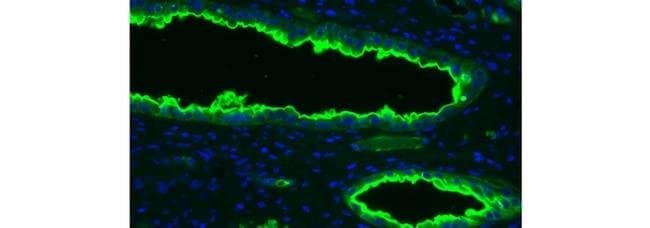
Invitrogen™ Blood Group Antigen H (O) Type 1 Monoclonal Antibody (17-206), Alexa Fluor™ 488, eBioscience™, Invitrogen™

Mouse Monoclonal Antibody
Brand: Invitrogen™ 53-9810-82
This item is not returnable.
View return policy
Description
The MAb 17-206 recognizes the human blood group antigen H (O) type 1, a subtype primarily found in epithelial and secretory cells. The precursor H antigen is modified by addition of saccharides to carbohydrate chains of proteins and lipids on erythrocytes and epithelial cells. The type, attachment, location, and sequence of saccharides determines the blood group antigen subtype and is mediated by multiple glycosyl transferases. Depending on ABO blood type, the H antigen is converted into either the A antigen, B antigen, both the A and B antigen, or left unconverted (O antigen). Evidence that the blood group antigen H is not expressed in tumor cells and that the level correlates with disease progression suggests that the blood group antigen H may be involved in cell proliferation, cell adhesion, and angiogenesis, although its exact function remains to be determined. The 17-206 antibody does not recognize blood group antigen H (O) type 2.
The H antigen is a precursor to the ABO blood groupantigens, present in people of all common blood types. The Bombay phenotype (hh) does not express antigen H on red blood cells, and therefore this type will also lack A or B antigens, similar to the O blood group. However, unlike O group, the H antigen is absent, hence the individuals produce isoantibodies to antigen H as well as to both A and B antigens. If they receive blood from someone with O blood group, the anti-H antibodies will bind to the H antigen on the red blood cells of the donor blood and destroy the RBCs bycomplement-mediated lysis. Therefore, people with Bombay phenotype can receive blood only from otherhhdonors, although they can donate as though they were type O. Some individuals with the blood group A1 may also be able to produce anti-H antibodies due to the complete conversion of all the H antigen to A1 antigen. Production of the H antigen, or its deficiency in the Bombay phenotype, is controlled at the H locus on chromosome 19. The H locus contains threeexonsthat span more than 5kbof genomic DNA, and encodes thefucosyltransferasethat produces the H antigen on RBCs. The H antigen is a carbohydrate sequence withcarbohydrateslinked mainly to protein (with a minor fraction attached toceramidemoiety).
Specifications
| Blood Group Antigen H (O) Type 1 | |
| Monoclonal | |
| 0.5 mg/mL | |
| PBS with 0.09% sodium azide; pH 7.2 | |
| Mouse | |
| 100 μg | |
| Primary | |
| 4°C, store in dark, DO NOT FREEZE! | |
| Liquid |
| Immunohistochemistry (Frozen), Immunohistochemistry (Paraffin), Immunocytochemistry | |
| 17-206 | |
| Alexa Fluor 488 | |
| ABH; BG-H; BG-H1; group h | |
| Affinity chromatography | |
| RUO | |
| Human | |
| Antibody | |
| IgG3 |
Product Content Correction
Your input is important to us. Please complete this form to provide feedback related to the content on this product.
Product Title
Spot an opportunity for improvement?Share a Content Correction