missing translation for 'onlineSavingsMsg'
Learn More
Learn More
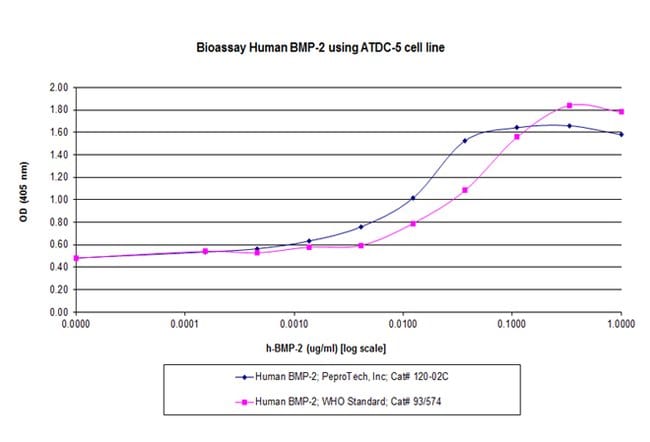
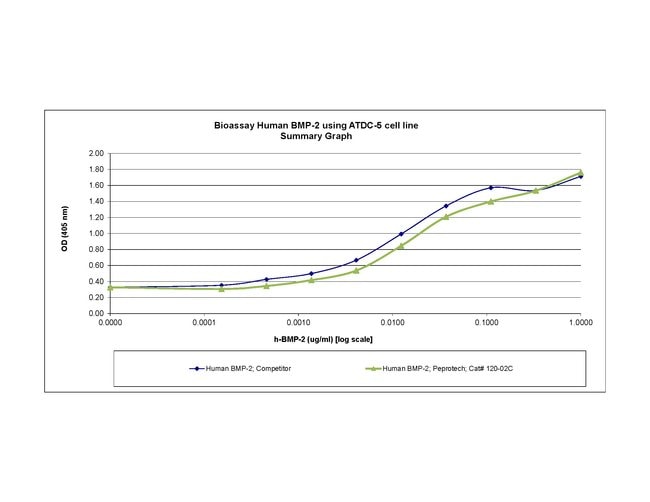

Gibco™ Human/Mouse/Rat BMP-2 Recombinant Protein, PeproTech®
Click to view available options
Quantité:
1 mg
10 μg
100 μg
2 μg
250 μg
50 μg
500 μg
Conditionnement:
100µg
10µg
1mg
250µg
2µg
500µg
50µg
Description
Recombinant Human/Murine/Rat BMP-2 derived from CHO cells is a homodimeric glycoprotein that consists of two 114 amino acid polypeptide chains linked by a single disulfide bond. Due to glycosylation, CHO cell-derived Human/Murine/Rat BMP-2 migrates at an apparent molecular weight of approximately 28-29 kDa by SDS-PAGE analysis under non-reducing conditions. This product is shipped at ambient temperature. For storage, handling and reconstitution information, please see the lot-specific Certificate of Analysis
Bone Morphogenic Proteins (BMP) are members of the TGF-beta superfamily that affect bone and cartilage formation (Hogan 1996, Reddi 1998 and Francis-West et al. 1999). Mature BMPs are 30-38 kDa proteins that assume a TGF-beta -like cysteine knot configuration. Lovostatin increases bone formation by turning on the bmp-2 gene (Mundy et al. 1999). BMPs stimulate the production of specific bone matrix proteins and alter stromal cell and osteoclast proliferation (Macias et al. 1999, Lecanda et al. 1997). BMPs may also be an important factor for development of the viscera, with roles in cell proliferation, apoptosis, differentiation, and morphogenesis (Hogan 1996, Dale and Wardle 1999). BMPs appear to be responsible for normal dorsal/ventral patterning. Like TGF-beta, BMPs bind to a type II receptor, which then recruits the transducing type I receptor unit, activating the Smad protein signaling pathway (Massague 1994, Derynck 1997, Attisano 1993).

Spécification
Spécification
| Numéro d’adhésion | P12643, P21274, P49001 |
| À utiliser avec (application) | Functional Assay |
| Formule | protein with no preservative |
| Identification génétique (Entrez) | 12156, 29373, 650 |
| Poids moléculaire | 25.8 kDa |
| Nom | Human/Mouse/Rat BMP-2 |
| Quantité | 500 μg |
| Source | CHO cells |
| État réglementaire | RUO |
| Concentration en endotoxines | <1 EU/ μg |
| Afficher plus |
Correction du contenu d'un produit
Veuillez fournir vos retours sur le contenu du produit en remplissant le formulaire ci-dessous.
Nom du produit
Vous avez repéré une opportunité d'amélioration ?Partager une correction de contenu