missing translation for 'onlineSavingsMsg'
Learn More

Invitrogen™ CD69 Monoclonal Antibody (H1.2F3), PE-eFluor™ 610, eBioscience™, Invitrogen™
GREENER_CHOICE

Code produit 17134083
Change view
Click to view available options
Quantité:
100 μg
25 μg
Conditionnement:
100µg
25µg
2 product options available for selection
Product selection table with 2 available options. Use arrow keys to navigate and Enter or Space to select.
Code produit Quantité unitSize
17134083 100 μg 100µg
17124083 25 μg 25µg
Use arrow keys to navigate between rows. Press Enter or Space to select a product option. 2 options available.
2 options
Les retours ne sont pas autorisés pour ce produit. Afficher la politique du retour.
Code produit 17134083 Fournisseur Invitrogen™ Code fournisseur 61069182

Please to purchase this item. Need a web account? Register with us today!

Les retours ne sont pas autorisés pour ce produit. Afficher la politique du retour.

Armenian Hamster Monoclonal Antibody

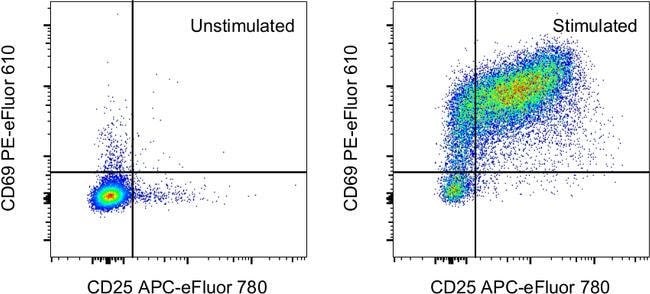
The H1.2F3 MAb reacts with mouse CD69, also known as very early activation antigen (VEA). CD69 is approximately 35 kDa and is expressed on the surface as a disulfide-linked dimer. While a small subset of lymphocytes in the thymus, spleen and lymph nodes express this antigen, activation of both T and B cells rapidly upregulates the surface expression of CD69, suggesting a role for CD69 in lymphocyte development and activation.

CD69 (AIM, Active Inducer Molecule) is a gp28/34 disulfide bonded homodimer with a molecular weight of 60 kDa under non-reducing conditions. CD69 contains one or two N linked oligosacaride and the molecule is present on activated platelets. In normal peripheral blood a variable percentage of cells express the CD69 antigen, and it is involved in lymphocyte signal transduction. Expression CD69 is induced upon activation of T lymphocytes, and may play a role in proliferation. Furthermore, the protein may act to transmit signals in natural killer cells and platelets. Alternative splicing results in multiple transcript variants of CD69. Diseases associated with CD69 dysfunction include coccidiodomycosis and asthma.
TRUSTED_SUSTAINABILITY

Spécification

Antigène CD69
Applications Flow Cytometry
Classification Monoclonal
Clone H1.2F3
Concentration 0.2 mg/mL
Conjugué PE-eFluor 610
Formule PBS with 0.09% sodium azide; pH 7.2
Expression CD69
Numéro d’ordre du gène P37217
Alias de gène 5830438K24Rik; Activation inducer molecule; activation inducer molecule (AIM/CD69); AI452015; AIM; BL-AC/P26; CD69; CD69 antigen; CD69 antigen (p60, early T-cell activation antigen); CD69 molecule; CLEC2C; C-type lectin domain family 2 member C; C-type lectin domain family 2, member C; EA1; early activation antigen CD69; early lymphocyte activation antigen; early T-cell activation antigen p60; GP32/28; leukocyte surface antigen Leu-23; MLR-3; VEA; Very Early Activation Antigen
Symboles de gène(s) CD69
Espèces hôtes Armenian Hamster
Méthode de purification Affinity chromatography
Quantité 100 μg
État réglementaire RUO
Primaire ou secondaire Primary
Identification génétique (Entrez) 12515
Espèces cibles Mouse
Contenu et stockage 4°C, store in dark, DO NOT FREEZE!
Type de produit Antibody
Forme Liquid
Isotype IgG
Afficher plus Afficher moins
Nom du produit
Sélectionnez un problème

En cliquant sur Soumettre, vous reconnaissez que vous pouvez être contacté par Fisher Scientific au sujet des informations que vous avez fournies dans ce formulaire. Nous ne partagerons pas vos informations à d'autres fins. Toutes les informations de contact fournies seront également conservées conformément à notre politique de confidentialité. Politique de confidentialité.