missing translation for 'onlineSavingsMsg'
Learn More
Learn More
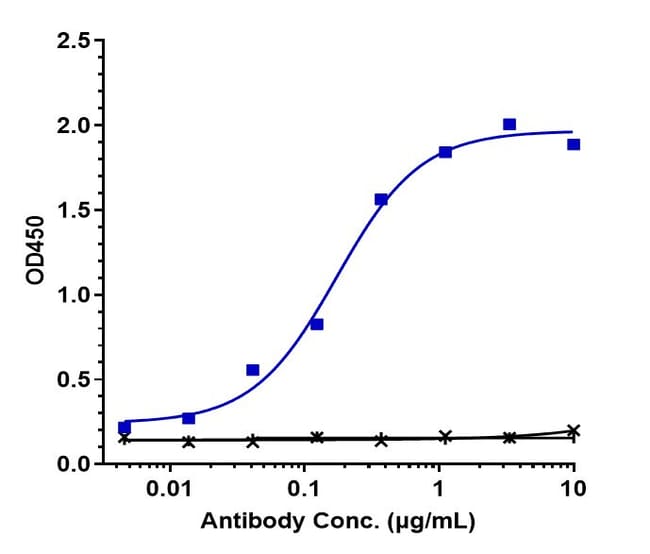
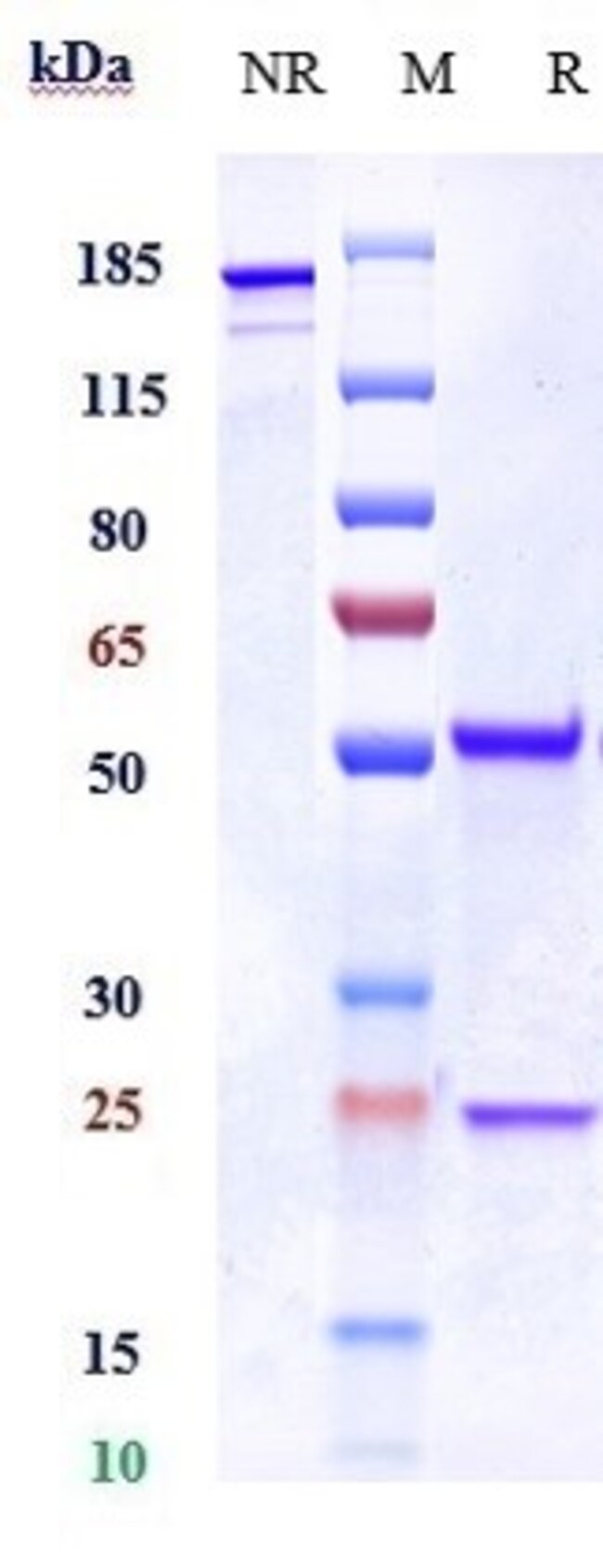
Invitrogen™ CXCR3 Biosimilar Recombinant Monoclonal Antibody

Description
For reconstitution, add sterile, distilled water to achieve a final antibody concentration of 1 mg/mL. Gently shake to solubilize the protein completely. Do not vortex. Reconstituted products should be stored at -80 °. This antibody can also be cross referenced by the term Genzyme patent anti-CXCR3.
This gene encodes a G protein-coupled receptor with selectivity for three chemokines, termed IP10 (interferon-g-inducible 10 kDa protein), Mig (monokine induced by interferon-g) and I-TAC (interferon-inducible T cell a-chemoattractant). IP10, Mig and I-TAC belong to the structural subfamily of CXC chemokines, in which a single amino acid residue separates the first two of four highly conserved Cys residues. Binding of chemokines to this protein induces cellular responses that are involved in leukocyte traffic, most notably integrin activation, cytoskeletal changes and chemotactic migration. Inhibition by Bordetella pertussis toxin suggests that heterotrimeric G protein of the Gi-subclass couple to this protein. Signal transduction has not been further analyzed but may include the same enzymes that were identified in the signaling cascade induced by other chemokine receptors. As a consequence of chemokine-induced cellular desensitization (phosphorylation-dependent receptor internalization), cellular responses are typically rapid and short in duration. Cellular responsiveness is restored after dephosphorylation of intracellular receptors and subsequent recycling to the cell surface. This gene is prominently expressed in in vitro cultured effector/memory T cells, and in T cells present in many types of inflamed tissues. In addition, IP10, Mig and I-TAC are commonly produced by local cells in inflammatory lesion, suggesting that this gene and its chemokines participate in the recruitment of inflammatory cells. Therefore, this protein is a target for the development of small molecular weight antagonists, which may be used in the treatment of diverse inflammatory diseases. Multiple transcript variants encoding different isoforms have been found for this gene.

Spécification
Spécification
| Antigène | CXCR3 Biosimilar |
| Applications | ELISA, Flow Cytometry, Functional Assay, Surface Plasmon Resonance |
| Classification | Recombinant Monoclonal |
| Concentration | 1 mg/mL |
| Conjugué | Unconjugated |
| Formule | 25mM histidine with 8% sucrose, 0.01% Tween 80 and no preservative; pH 6.2 |
| Espèces hôtes | Human |
| Méthode de purification | Protein A |
| Quantité | 100 μg |
| État réglementaire | RUO |
| Afficher plus |
Nom du produit
En cliquant sur Soumettre, vous reconnaissez que vous pouvez être contacté par Fisher Scientific au sujet des informations que vous avez fournies dans ce formulaire. Nous ne partagerons pas vos informations à d'autres fins. Toutes les informations de contact fournies seront également conservées conformément à notre politique de confidentialité. Politique de confidentialité.
Vous avez repéré une opportunité d'amélioration ?