missing translation for 'onlineSavingsMsg'
Learn More
Learn More


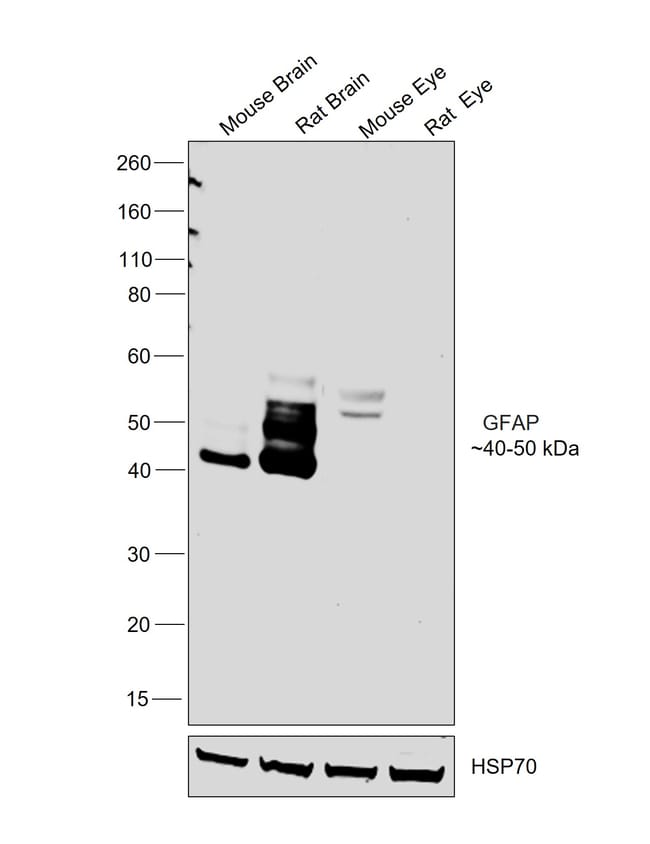
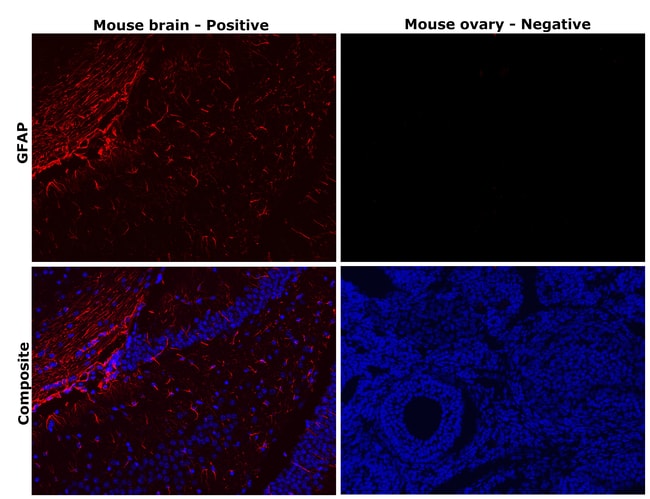
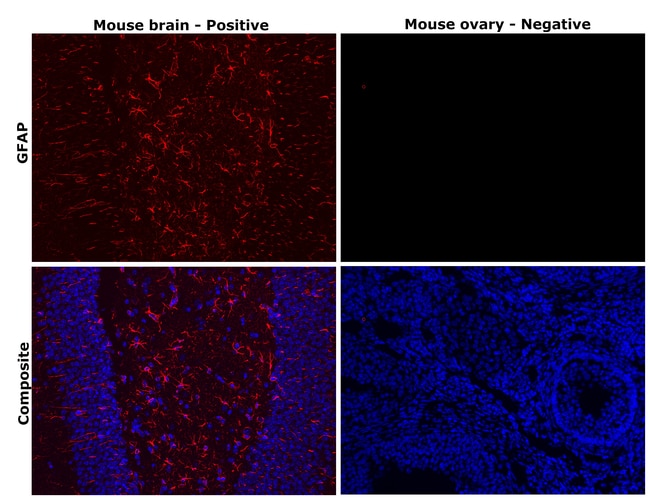
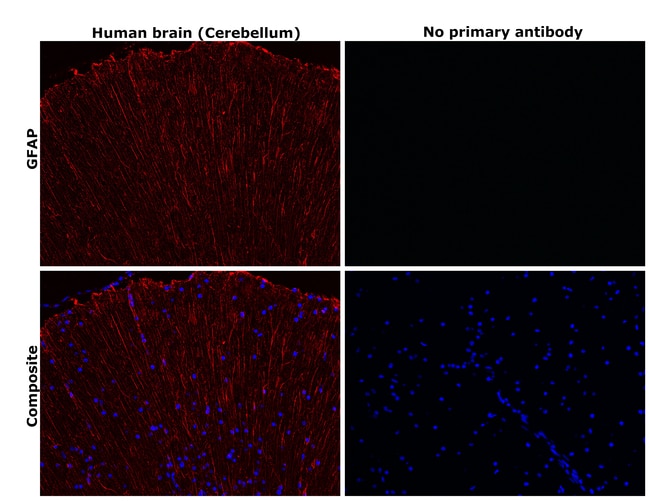
Invitrogen™ GFAP Monoclonal Antibody (2.2B10)
Description
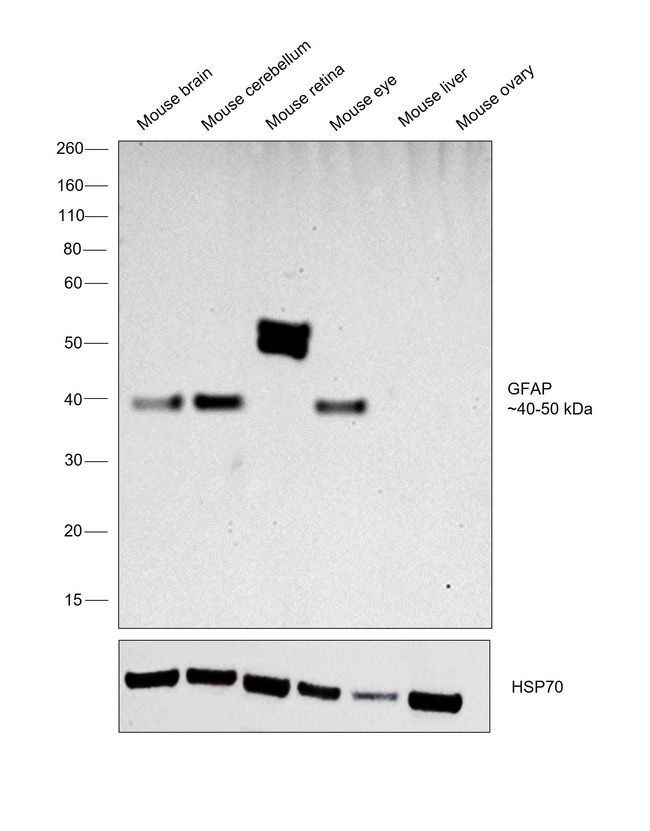
GFAP Monoclonal Antibody for ELISA, Flow, ICC/IF, IHC, IHC (P), IP, Western Blot
GFAP (Glial fibrillary acidic protein) is a member of the class III intermediate filament protein family. GFAP is heavily and specifically expressed in astrocytes and certain astroglia of the central nervous system, in satellite cells of peripheral ganglia, and in non-myelinating Schwann cells of peripheral nerves. In addition, neural stem cells strongly express GFAP. Antibodies to GFAP are very useful as markers of astrocytic cells. In addition, many types of brain tumor, presumably derived from astrocytic cells, heavily express GFAP. GFAP is also found in the lens epithelium, Kupffer cells of the liver, in some cells in salivary tumors and has been reported in erythrocytes. GFAP is used as a marker to distinguish astrocytes from other glial cells during development. Mutations in this gene cause Alexander disease, a rare disorder of astrocytes in the central nervous system. Alternative splicing of the GFAP gene results in multiple transcript variants encoding distinct isoforms.

Spécification
Spécification
| Antigène | GFAP |
| Applications | ELISA, Flow Cytometry, Immunohistochemistry, Immunohistochemistry (Paraffin), Immunoprecipitation, Western Blot, Immunocytochemistry |
| Classification | Monoclonal |
| Clone | 2.2B10 |
| Concentration | 0.5 mg/mL |
| Conjugué | Unconjugated |
| Formule | PBS with 0.1% sodium azide |
| Expression | GFAP |
| Numéro d’ordre du gène | P03995, P14136, P47819, Q28115 |
| Alias de gène | 6330404F12Rik; 65 kDa glutamic acid decarboxylase; AI836096; ALXDRD; Astrocyte or Intermediate Filament Protein; cb345; class III intermediate filament protein; etID36982.3; FLJ45472; GAD(65); Gad2; Gad-2; GAD65; GAD-65; GFAP; GFAP epsilon; gfap protein; gfapl; glial fibrillary acidic protein; Glial Fibrillary Acidic Protein (GFAP); glial fibrillary acidic protein alpha; glutamate decarboxylase 2; Glutamate decarboxylase 65 kDa isoform; glutamic acid decarboxylase 2; I79_011607; intermediate filament; intermediate filament protein; intermediate filament protein; GFAP; Unknown (protein for MGC:139638); wu:fb34h11; wu:fk42c12; xx:af506734; zgc:110485; zGFAP; intermediate filament protein; zrf-1 antigen |
| Afficher plus |
Nom du produit
En cliquant sur Soumettre, vous reconnaissez que vous pouvez être contacté par Fisher Scientific au sujet des informations que vous avez fournies dans ce formulaire. Nous ne partagerons pas vos informations à d'autres fins. Toutes les informations de contact fournies seront également conservées conformément à notre politique de confidentialité. Politique de confidentialité.
Vous avez repéré une opportunité d'amélioration ?