missing translation for 'onlineSavingsMsg'
Learn More
Learn More
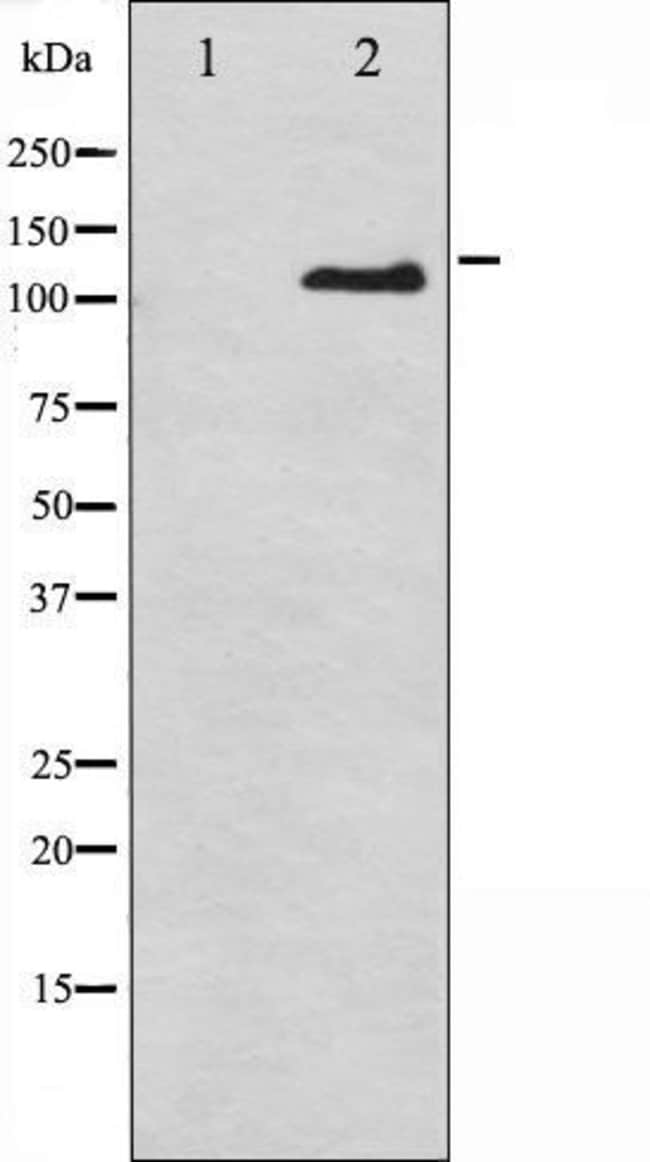
Invitrogen™ Phospho-CD61 (Tyr785) Polyclonal Antibody

Description
Antibody detects endogenous levels of Integrin beta3 only when phosphorylated at Tyrosine 785.
CD61, also known as GPIIIa or ITGB3, is a 105 kDa glycoprotein expressed on activated T cells, granulocytes, megakaryocytes, platelets, and their precursors. It plays a crucial role in platelet aggregation and functions as a receptor for fibrinogen, fibronectin, von Willebrand factor, vitronectin, and thrombospondin. CD61 forms heterodimeric complexes by associating non-covalently with integrin alpha subunits: alphaV (CD51) to create the Vitronectin Receptor and alphaIIb (CD41) to form gpIIb/IIIa. These complexes are responsible for adhesion to extracellular matrix components, facilitating cell adhesion and cell-surface mediated signaling. CD61 is expressed on platelets and megakaryocytes in association with CD41, and on endothelial cells, monocytes, and osteoclasts in association with CD51. The protein product of CD61 is composed of an alpha chain and a beta chain, which can combine with multiple partners to form different integrins. Its involvement in cell adhesion and signaling underscores its importance in normal physiological processes. Dysfunction of CD61 is associated with diseases such as Glanzmann Thrombasthenia and Platelet type-16 Bleeding Disorder, highlighting its critical role in hemostasis and platelet function.

Spécification
Spécification
| Antigène | Phospho-CD61 (Tyr785) |
| Applications | Western Blot, Immunocytochemistry |
| Classification | Polyclonal |
| Concentration | 1 mg/mL |
| Conjugué | Unconjugated |
| Formule | PBS with 50% glycerol and 0.02% sodium azide; pH 7.4 |
| Expression | ITGB3 |
| Numéro d’ordre du gène | O54890, P05106 |
| Alias de gène | antigen CD61; BDPLT16; BDPLT2; beta3 integrin; CD61; EGK_08849; glycoprotein GPIIIa; glycoprotein IIIa; GP3A; GPIIIa; GT; INGRB3; integrin beta 3; integrin beta 3 (Cd61); integrin beta-3; integrin beta-3 subunit; integrin subunit beta 3; integrin, beta 3; integrin, beta 3 (platelet glycoprotein IIIa, antigen CD61); ITGB3; platelet glycoprotein IIIa; platelet glycoprotein IIIa integrin subunit beta 3; platelet gpIIIa; platelet membrane glycoprotein IIIa |
| Symboles de gène(s) | ITGB3 |
| Afficher plus |
Nom du produit
En cliquant sur Soumettre, vous reconnaissez que vous pouvez être contacté par Fisher Scientific au sujet des informations que vous avez fournies dans ce formulaire. Nous ne partagerons pas vos informations à d'autres fins. Toutes les informations de contact fournies seront également conservées conformément à notre politique de confidentialité. Politique de confidentialité.
Vous avez repéré une opportunité d'amélioration ?