missing translation for 'onlineSavingsMsg'
Learn More
Learn More
Invitrogen™ PSD-95 Polyclonal Antibody

Description
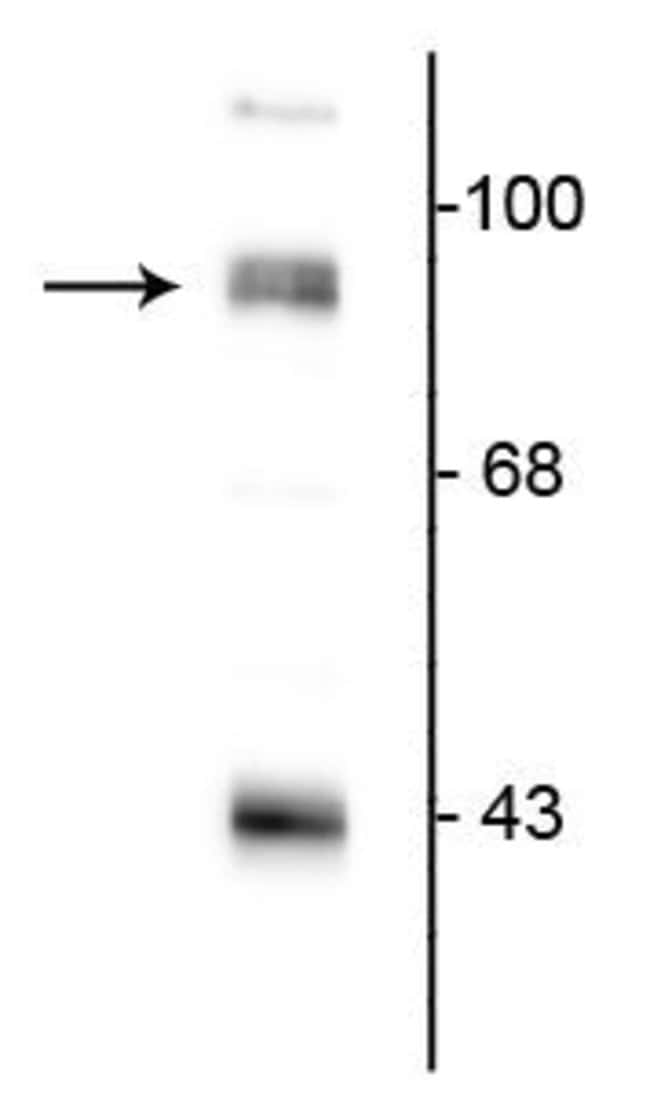
This antibody is predicted to react with bovine, human, mouse, non-human primate and zebrafish based on 100% sequence homology. This antibody is specific for ~95 kDa PSD-95 protein.
Post Synaptic Density 95 kDa (PSD-95), also known as synapse associated protein 90 kDa (SAP90), is one of a family of membrane-associated proteins found in the postsynaptic density in forebrain neurons and certain presynaptic structures in the cerebellum. Like other members of the family, PSD-95 has three 90 amino acid repeats called PDZ domains followed by an SH3 domain and a yeast guanylate kinase homology (GuK) domain. PSD-95 is believed to participate in the clustering of certain proteins, including NMDA receptors, Shaker-type potassium channels at the synaptic membrane in central nervous system (CNS) neurons. There are two principal modes of interaction between PSD-95 and other proteins. NMDA receptors and shaker-type potassium channels both share C-terminal sequence homology consisting of a threonine/serine-X-valine-COOH (T/SXV) motif. Other neuronal proteins that share this motif (beta 1 adrenergic receptor, some serotonin receptors, some sodium channel subunits, and additional potassium channel subunits), and some of these proteins may interact with PSD-95 by binding to its PDZ domains. Neuronal nitric oxide synthase (nNOS), which lacks the T/SXV motif but which has its own PDZ domain, has been shown to associate with PSD-95 in vitro through a pseudo-homotypic PDZ-PDZ interaction.

Spécification
Spécification
| Antigène | PSD-95 |
| Applications | Western Blot |
| Classification | Polyclonal |
| Concentration | 0.25 mg/mL |
| Conjugué | Unconjugated |
| Formule | 0.01M HEPES with 100μg/mL BSA, 50% glycerol, 0.15M NaCl and no preservative; pH 7.5 |
| Expression | DLG4 |
| Numéro d’ordre du gène | P31016, Q62108 |
| Alias de gène | discs large homolog 4; discs large MAGUK scaffold protein 4; discs, large homolog 4; discs, large homolog 4 (Drosophila); disks large homolog 4; Dlg4; Dlgh4; FLJ97752; FLJ98574; post synaptic density; postsynaptic density protein 95; post-synaptic density protein 95; PSD95; PSD-95; PSD-95 alpha 2b; PSD-95 beta; Sap90; SAP-90; SAP90A; Synapse-associated protein 90; synapse-associated protein SAP90; Tax interaction protein 15 |
| Symboles de gène(s) | DLG4 |
| Afficher plus |
Nom du produit
En cliquant sur Soumettre, vous reconnaissez que vous pouvez être contacté par Fisher Scientific au sujet des informations que vous avez fournies dans ce formulaire. Nous ne partagerons pas vos informations à d'autres fins. Toutes les informations de contact fournies seront également conservées conformément à notre politique de confidentialité. Politique de confidentialité.
Vous avez repéré une opportunité d'amélioration ?