missing translation for 'onlineSavingsMsg'
Learn More
Learn More
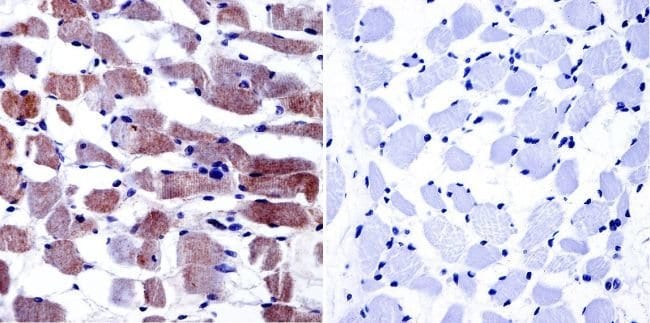

Invitrogen™ CaV1.1 Monoclonal Antibody (1A)
Mouse Monoclonal Antibody
Brand: Invitrogen™ MA3920
This item is not returnable.
View return policy
Description
MA3-920 detects 1,4-dihydropyridine (DHP) receptor alpha-1 subunit in human, rat, mouse, guinea pig and rabbit skeletal muscle. The DHP Receptor alpha-1 protein is also known as CACNA1S or Cav1.1 alpha-1 subunit. MA3-920 has been successfully used in Western blot, FACS, immunohistochemistry and immunoprecipitation procedures. By Western blot, this antibody detects an ~200 kDa protein representing the DHP receptor in rat skeletal muscle extracts. Immunohistochemical staining of DHP receptor in rabbit skeletal muscle with MA3-920 results in double rows of discrete punctate staining representing pairs of triads on the opposing sides of the Z-lines. This product can be used to inhibit the DHP-sensitive calcium current in BC3H1 mouse muscle cells. The MA3-920 antigen is purified rabbit muscle T-tubule DHP receptor.
Voltage-sensitive calcium channels mediate the entry of calcium into many types of excitable cells and thus play a key role in neurotransmitter release and excitation-contraction (E-C) coupling. The 1,4-dihydropyridines (DHPs) are synthetic organic compounds which can be used to identify the L-type calcium channels that are found in all types of vertebrate muscle, neuronal and neuroendocrine cells. The DHP receptor is part of the L-type calcium channel complex and is thought to be the voltage sensor in E-C coupling. The purified DHP receptor isolated from triads is composed of at least four subunits. The alpha-1 subunit contains the binding site for the DHPs and shows high sequence homology to the voltage gated sodium channel. The alpha-2 subunit is a large glycoprotein associated with the DHP receptor which was first described in skeletal muscle and is also found in high concentrations in other excitable tissues such as cardiac muscle and brain and in low concentrations in most other tissues studied. The other two subunits that co-purify with the DHP receptor are termed beta and gamma.
Specifications
| CaV1.1 | |
| Monoclonal | |
| 1 mg/mL | |
| PBS with 0.05% sodium azide; pH 7.4 | |
| P07293, Q02485, Q02789, Q13698 | |
| CACNA1S | |
| Purified rabbit muscle T-tubule dihydropyridine receptor. | |
| 200 μL | |
| Primary | |
| Guinea Pig, Human, Mouse, Rabbit, Rat | |
| Antibody | |
| IgG1 |
| Flow Cytometry, Immunohistochemistry (Frozen), Immunohistochemistry (Paraffin), Immunoprecipitation, Western Blot | |
| 1A | |
| Unconjugated | |
| CACNA1S | |
| AW493108; CACH1; Cacn1; Cacna1s; Cacnl1a3; calcium channel, L type, alpha 1 polypeptide, isoform 3 (skeletal muscle, hypokalemic periodic paralysis); calcium channel, L type, alpha-1 polypeptide, isoform 3, skeletal muscle; calcium channel, voltage-dependent, L type, alpha 1S subunit; calcium voltage-gated channel subunit alpha1 S; Cav1.1; Cav1.1 alpha-1; CCHL1A3; DHP; DHPR; DHPR alpha1s; dihydropyridine calcium channel receptor protein; dihydropyridine receptor; dihydropyridine receptor alpha 1 subunit; dihydropyridine receptor alpha 1S; dihydropyridine receptor alpha-1S subunit; dihydropyridine-sensitive L-type calcium channel alpha-1 subunit; fmd; HOKPP; HOKPP1; hypoPP; mdg; MHS5; muscle dysgenesis; ROB1; sj; TTPP1; unnamed protein product; voltage-dependent L-type calcium channel subunit alpha-1S; Voltage-gated calcium channel subunit alpha Cav1.1 | |
| Mouse | |
| Protein A | |
| RUO | |
| 100009585, 100734741, 12292, 682930, 779 | |
| -20°C, Avoid Freeze/Thaw Cycles | |
| Liquid |
Product Content Correction
Your input is important to us. Please complete this form to provide feedback related to the content on this product.
Product Title
Spot an opportunity for improvement?Share a Content Correction