missing translation for 'onlineSavingsMsg'
Learn More
Learn More
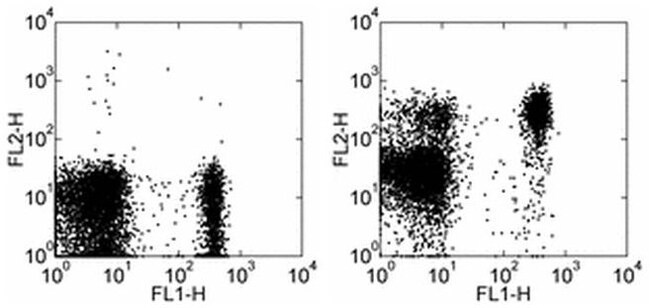
CD197 (CCR7) Monoclonal Antibody (4B12), Biotin, eBioscience™, Invitrogen™

Rat Monoclonal Antibody
69.75€ - 452.00€
Spécification
| Antigène | CD197 (CCR7) |
|---|---|
| Clone | 4B12 |
| Concentration | 0.5 mg/mL |
| Applications | Flow Cytometry |
| Classification | Monoclonal |
| Code produit | Marque | Quantité | Prix | Quantité et disponibilité | |||||
|---|---|---|---|---|---|---|---|---|---|
| Code produit | Marque | Quantité | Prix | Quantité et disponibilité | |||||
|
15289759
|
Invitrogen
13-1971-80 |
25 μg | |||||||
|
15299759
|
Invitrogen™
13-1971-82 |
100 μg |
306.00€
100µg |
Veuillez vous connecter pour pouvoir commander cet article. Besoin d'un compte web? Créer le vôtre dès maintenant! | |||||
|
15209769
|
Invitrogen™
13-1971-85 |
500 μg |
452.00€
500µg |
Veuillez vous connecter pour pouvoir commander cet article. Besoin d'un compte web? Créer le vôtre dès maintenant! | |||||
Description
Description: The 4B12 monoclonal antibody reacts with mouse CCR7, also known as EBI-1 and CD197. CCR7 is a chemokine receptor for the chemokines CCL19 (CKβ11, ELC, MIP3β, Scya19, Exodus-3) and CCL21 (CKβ9, SLC, MIP2β, Scya21, Exodus-2). In recent years, the role of chemokines in directing the migration of lymphocytes has been well-characterized. One of the most important mediators of homeostatic trafficking of naive T cells to secondary lymphoid organs (SLO) is the chemokine receptor CCR7. Binding of its ligands, CCL19 and CCL21, mediates the trans endothelial migration of T cells across high endothelial venules into SLO. It has also been demonstrated that CCR7 plays a role in the localization of dendritic cells and B cells during an immune response. CCR7 is a chemokine receptor for the chemokines CCL19 (CKβ11, ELC, MIP3β, Scya19, Exodus-3) and CCL21 (CKβ9, SLC, MIP2β, Scya21, Exodus-2). In addition to its significant role in the chemotaxis of lymphocytes, human CCR7 has also been recognized as a marker for a distinct subset of memory T cells, the central memory (TCM) population. These cells are characterized by the expression of CCR7 and CD62L and reside within peripheral lymphoid organs. CCR7 also plays a role in thymocyte development and its deficiency leads to disturbed thymic architecture, aberrant T cell development, and limited thymocyte expansion.
CCR7 is a member of the G protein coupled receptor family, which is a subfamily of chemokines. CCR7 was identified to be induced by the Epstein Barr virus (EBV), and is thought to be a mediator of EBV effects on B lymphocytes. CCR7 has been reported to be expressed in blood, bone marrow, lymph node, and intestine. CCR7 is particularly expressed in lymphoid tissues and in activated B and T lymphocytes and has been shown to control the migration of memory T cells to inflamed tissues, as well as stimulate dendritic cell maturation. The chemokine (C-C motif) ligand 19 (CCL19/ECL) has been reported to be a specific ligand of this receptor. ESTs have been isolated from blood, embryo, lymph node, and thymus libraries. Receptors for the C - C chemokine family include CCR 1, CCR 2A, CCR 3, CCR 4, CCR 5 and the Duffy blood group antigen. The C-C receptors are important in the function of T cell chemotaxis and migration of phagocytic cells to sites of inflammation.Spécification
| CD197 (CCR7) | |
| 0.5 mg/mL | |
| Monoclonal | |
| Liquid | |
| RUO | |
| P47774 | |
| Ccr7 | |
| Primary | |
| 4° C, store in dark, DO NOT FREEZE! | |
| Ccr7 |
| 4B12 | |
| Flow Cytometry | |
| Biotin | |
| Rat | |
| Mouse | |
| 12775 | |
| IgG2a κ | |
| Affinity chromatography | |
| Antibody |
For Research Use Only.
Vous avez repéré une opportunité d'amélioration ?Partager une correction de contenu
Correction du contenu d'un produit
Veuillez fournir vos retours sur le contenu du produit en remplissant le formulaire ci-dessous.
Nom du produit