missing translation for 'onlineSavingsMsg'
Learn More
Learn More
Invitrogen™ CD199 (CCR9) Monoclonal Antibody (eBioCW-1.2 (CW-1.2)), FITC, eBioscience™, Invitrogen™

Mouse Monoclonal Antibody
Marque: Invitrogen™ 11-1991-82
Les retours ne sont pas autorisés pour ce produit.
Afficher la politique du retour.
Description
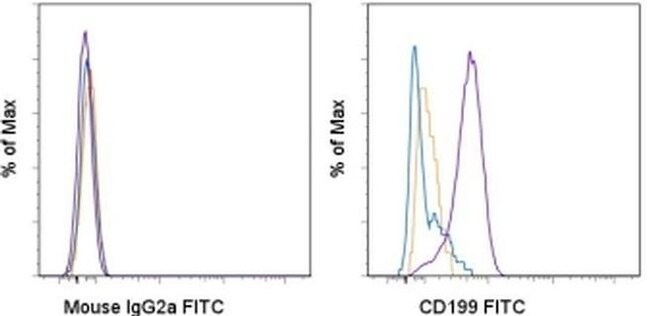
Description: The eBioCW-1.2 monoclonal antibody reacts with mouse CCR9 (CD199), which is the receptor for thymus-expressed chemokine (TECK). CCR9 is a member of the G protein coupled receptor (GPCR) supergene family, and is involved in trafficking of T cell progenitors within the thymus. CCR9 expression during thymocyte development commences at the double-negative (DN) 3 stage (CD4-CD8-CD25+CD44-), peaks in the double-positive (DP) stage (CD4+CD8+CD25-CD44-), and is down-regulated in commited CD4+ or CD8+ single-positive (SP) thymoyctes. CCR9-deficient mice show a mild impairment in thymoycte development. In the periphery, CCR9 is thought to be expressed on naive CD8+ T cells, but not on naive CD4+ T cells. Applications Reported: This eBioCW-1.2 (CW-1.2) antibody has been reported for use in flow cytometric analysis. Applications Tested: This eBioCW-1.2 (CW-1.2) antibody has been tested by flow cytometric analysis of mouse thymocytes and/or splenocytes. This can be used at less than or equal to 0.25 μg per test. A test is defined as the amount (μg) of antibody that will stain a cell sample in a final volume of 100 μL. Cell number should be determined empirically but can range from 10^5 to 10^8 cells/test. It is recommended that the antibody be carefully titrated for optimal performance in the assay of interest. Excitation: 488 nm; Emission: 520 nm; Laser: Blue Laser. Filtration: 0.2 μm post-manufacturing filtered.
The protein encoded by this gene is a member of the beta chemokine receptor family. It is predicted to be a seven transmembrane protein similar to G protein-coupled receptors. Chemokines and their receptors are key regulators of the thymocytes migration and maturation in normal and inflammation conditions. The specific ligand of this receptor is CCL25. It has been found that this gene is differentially expressed by T lymphocytes of small intestine and colon, suggested a role in the thymocytes recruitment and development that may permit functional specialization of immune responses in different segment of the gastrointestinal tract. This gene is mapped to the chemokine receptor gene cluster region. Two alternatively spliced transcript variants have been described.
Spécification
| CD199 (CCR9) | |
| Monoclonal | |
| 0.5 mg/mL | |
| PBS with 0.09% sodium azide; pH 7.2 | |
| Q9WUT7 | |
| Ccr9 | |
| Affinity chromatography | |
| RUO | |
| 12769 | |
| 4°C, store in dark, DO NOT FREEZE! | |
| Liquid |
| Flow Cytometry | |
| eBioCW-1.2 (CW-1.2) | |
| FITC | |
| Ccr9 | |
| A130091K22Rik; C-C chemokine receptor type 9; C-C CKR-9; C-C motif chemokine receptor 9; CC-CKR-9; Ccr9; CCR-9; CDw199; CDw199 antigen; chemokine (C-C motif) receptor 9; chemokine C-C receptor 10; Cmkbr10; G protein-coupled receptor 28; GPR28; GPR-9-6; G-protein coupled receptor 28 | |
| Mouse | |
| 100 μg | |
| Primary | |
| Mouse | |
| Antibody | |
| IgG2a |
Correction du contenu d'un produit
Veuillez fournir vos retours sur le contenu du produit en remplissant le formulaire ci-dessous.
Nom du produit
For Research Use Only.
Vous avez repéré une opportunité d'amélioration ?Partager une correction de contenu