missing translation for 'onlineSavingsMsg'
Learn More
Learn More
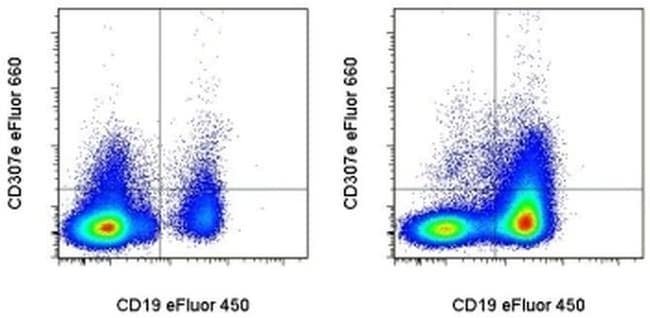
Invitrogen™ CD307e (FcRL5) Monoclonal Antibody (509F6), eFluor™ 660, eBioscience™
Mouse Monoclonal Antibody
394.00€
Spécification
| Antigène | CD307e (FcRL5) |
|---|---|
| Clone | 509F6 |
| Concentration | 5 μL/Test |
| Contenu et stockage | 4°C, store in dark, DO NOT FREEZE! |
| Applications | Flow Cytometry |
Description
Description: The 509F6 monoclonal antibody reacts with human CD307e which is also known as Fc receptor-like 5, FcRL5, FcRH5, or IRTA2. CD307e is a surface protein expressed selectively on naive mature B cells and on bone marrow plasma cells, and binds to all IgG isotypes. CD307e functions as an inhibitory coreceptor on mature B cells in humans via the recruitment of the phosphatase SHP-1 to its two immunoreceptor tyrosine-based inhibitory motifs (ITIM). CD307e can also exist in soluble form and high levels of soluble CD307e have been detected in the blood of patients with multiple myeloma, chronic lymphocytic leukemia, and mantle cell lymphoma. Because surface-bound CD307e is also highly-expressed on malignant B cells from multiple myeloma, chronic lymphocytic leukemia, and mantle cell lymphoma patients, CD307e may be a useful therapeutic target for the treatment of these cancers. Applications Reported: This 509F6 antibody has been reported for use in flow cytometric analysis. Applications Tested: This 509F6 antibody has been pre-titrated and tested by flow cytometric analysis of normal human peripheral blood cells. This can be used at 5 μL (1 μg) per test. A test is defined as the amount (μg) of antibody that will stain a cell sample in a final volume of 100 μL. Cell number should be determined empirically but can range from 10^5 to 10^8 cells/test. eFluor® 660 is a replacement for Alexa Fluor® 647. eFluor® 660 emits at 659 nm and is excited with t...
Fc receptor homologs (FcRH5), also known as IRTA2 proteins, are transmembrane proteins with sequence homology to classical Fc receptor families. FcRH5 function as activating or inhibitory receptors on discrete B cell populations and are involved in B-cell development and differentiation in peripheral lymphoid organs. FcRH5 expression is deregulated in multiple myeloma and Burkitt lymphoma cell lines with 1q21 abnormalities. FcRH5 may play a critical role for the pathogenesis of B-cell lymphoma.Spécification
| CD307e (FcRL5) | |
| 5 μL/Test | |
| Flow Cytometry | |
| eFluor 660 | |
| Mouse | |
| RUO | |
| PBS with BSA and 0.09% sodium azide; pH 7.2 | |
| Q96RD9 | |
| 83416 | |
| Primary | |
| Affinity chromatography |
| 509F6 | |
| 4°C, store in dark, DO NOT FREEZE! | |
| Monoclonal | |
| Liquid | |
| IgG2a κ | |
| Human | |
| FCRL5 | |
| BXMAS1; BXMAS1-like protein 2; CD307; CD307e; fc receptor homolog 3; Fc receptor homolog 5; Fc receptor like 5; Fc receptor-like 3; Fc receptor-like 5; Fc receptor-like protein 3; Fc receptor-like protein 5; Fcrh3; FCRH5; Fcrl3; Fcrl5; FcR-like protein 5; Immune receptor translocation-associated protein 2; immunoglobulin superfamily receptor translocation associated 2 (IRTA2); IRTA2; mBXMH2; moFcRH3; PRO820; rCG62831-like; UNQ503/PRO820 | |
| FCRL5 | |
| Antibody |
Vous avez repéré une opportunité d'amélioration ?Partager une correction de contenu
Correction du contenu d'un produit
Veuillez fournir vos retours sur le contenu du produit en remplissant le formulaire ci-dessous.
Nom du produit