missing translation for 'onlineSavingsMsg'
Learn More
Learn More
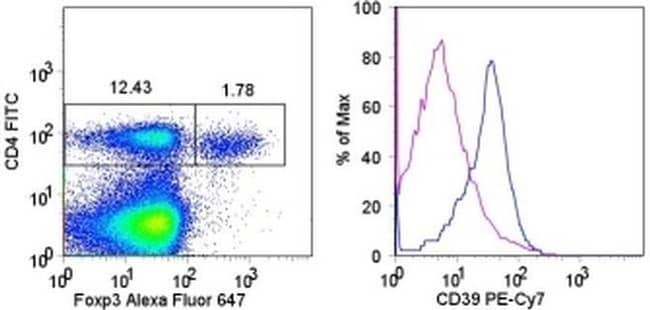
Invitrogen™ CD39 Monoclonal Antibody (24DMS1), PE-Cyanine7, eBioscience™, Invitrogen™
Rat Monoclonal Antibody
Marque: Invitrogen™ 25-0391-80
Les retours ne sont pas autorisés pour ce produit.
Afficher la politique du retour.
Description
Description: The 24DMS1 monoclonal antibody reacts with mouse CD39, also known as NTPDaseI. E-NTPDases are enzymes that convert nucleoside tri- and diphosphates (NTDPs) into nucleoside monophosphate (NMP), thereby removing toxic extracellular ATP and ADP. CD39 is the domit member of this family in the immune system and is involved in suppression of inflammation and control of platelet activation. CD39 can impact expression of CD73, another E-NTPase. Together, these molecules influence inflammation responses. CD39 is expressed on B cells, Langerhans cells and most monocytes. In addition, CD39 is found on a subset of CD4+ T cells that are mostly CD25+FoxP3+ T reg cells. T reg cells from CD39-null mice showed impaired suppressive properties in vitro and in vivo. Applications Reported: This 24DMS1 antibody has been reported for use in flow cytometric analysis. Applications Tested: This 24DMS1 antibody has been tested by flow cytometric analysis of mouse splenocytes. This can be used at less than or equal to 0.25 μg per test. A test is defined as the amount (μg) of antibody that will stain a cell sample in a final volume of 100 μL. Cell number should be determined empirically but can range from 10^5 to 10^8 cells/test. It is recommended that the antibody be carefully titrated for optimal performance in the assay of interest. Light sensitivity: This tandem dye is sensitive photo-induced oxidation.
CD39 is an integral membrane protein characterized by two transmembrane domains and forms a homotetramer structure. It is recognized as the most prominent ectoenzyme within the immune system, primarily functioning to remove toxic extracellular ATP by converting it into ADP or AMP. CD39 works in conjunction with CD73 to hydrolyze ATP and is well characterized on Langerhans cells. Originally identified on activated lymphocytes, CD39 is expressed on a variety of immune cells, including peripheral blood B cells, monocytes, and T cell clones. It is also found on a subset of T cells, B cells, and dendritic cells, with weaker expression observed on monocytes and granulocytes. The CD39 cell surface antigen is a 70-100kD molecule, and its expression is induced on T cells and increases on B cells as a late activation antigen. CD39 possesses intrinsic ecto-ATPase activity, playing a crucial role in modulating extracellular nucleotide levels and contributing to immune regulation.
Spécification
| CD39 | |
| Monoclonal | |
| 0.2 mg/mL | |
| PBS with 0.09% sodium azide; pH 7.2 | |
| P55772 | |
| ENTPD1 | |
| Affinity chromatography | |
| RUO | |
| 12495 | |
| 4°C, store in dark, DO NOT FREEZE! | |
| Liquid |
| Flow Cytometry | |
| 24DMS1 | |
| PE-Cyanine7 | |
| ENTPD1 | |
| 2610206B08Rik; AA408691; ATPDase; Cd39; CD39 antigen; DKFZp686D194; DKFZp686I093; ecto-apyrase; Ecto-ATP diphosphohydrolase 1; ecto-ATPase 1; ecto-ATPDase 1; Ectonucleoside triphosphate diphosphohydrolase 1; ENTPD1; FLJ40921; FLJ40959; Lymphoid cell activation antigen; NTPDase 1; NTPDase-1; SPG64 | |
| Rat | |
| 25 μg | |
| Primary | |
| Mouse | |
| Antibody | |
| IgG2b κ |
Correction du contenu d'un produit
Veuillez fournir vos retours sur le contenu du produit en remplissant le formulaire ci-dessous.
Nom du produit
For Research Use Only.
Vous avez repéré une opportunité d'amélioration ?Partager une correction de contenu