missing translation for 'onlineSavingsMsg'
Learn More
Learn More

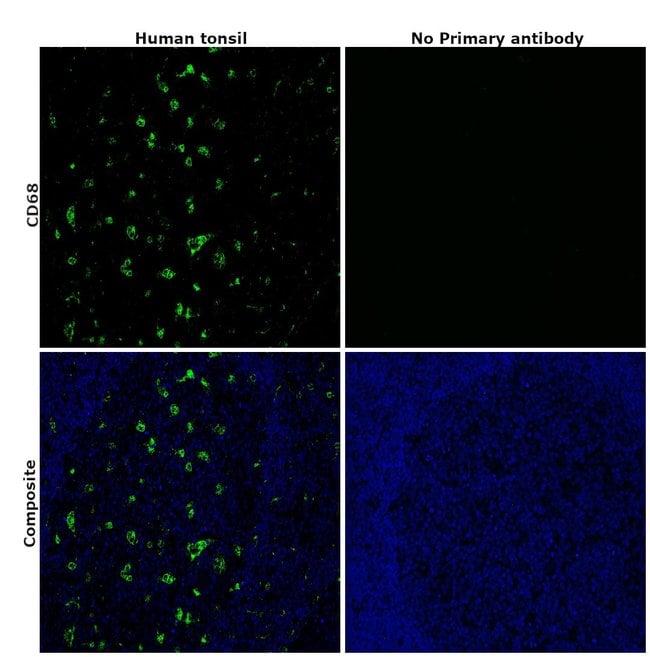
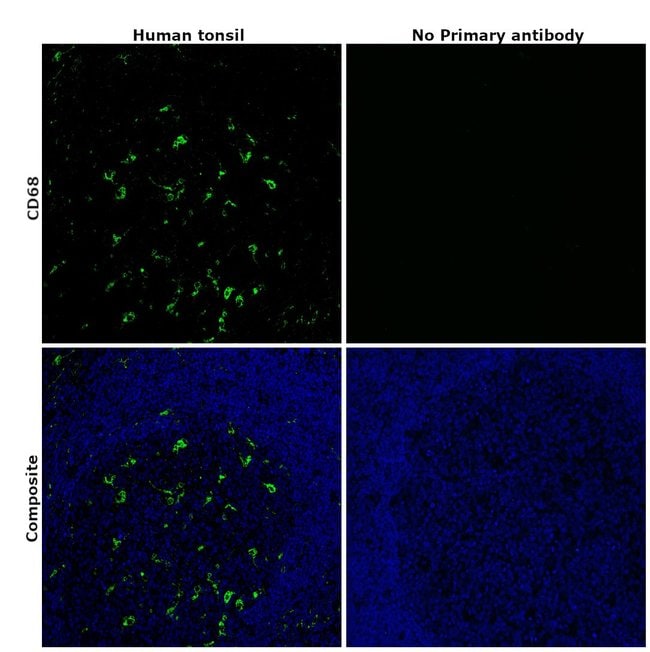


Invitrogen™ CD68 Monoclonal Antibody (KP1), eBioscience™, Invitrogen™

Mouse Monoclonal Antibody
Marque: Invitrogen™ 14-0688-82

Les retours ne sont pas autorisés pour ce produit.
Afficher la politique du retour.
Description
Description: The KP1 antibody reacts with human CD68 which belongs to the sialomucin family and is closely related to the family of lysosomal-associated membrane proteins (lamps) and scavenger receptor. CD68 is predomitly an intracellular protein, found mainly in the late endosomal compartment but can be detected in smaller amounts on the surface of mainly myeloid-derived cells; monocytes and macrophages, dendritic cells (and in some langerhan cells), neutrophils, basophils, mast cells, myeloid progenitor cells, and a subset of CD34+ hematopoietic bone marrow progenitor cells. The function has not been fully elucidated but based on homology and structure, CD68 may play a role in antigen processing or presentation and protection of the lysosomal membrane from hydrolytic enzymes. Reports have also shown expression in activated T cells, and about 40% of peripheral blood B-lymphocytes and 50% of all B-ALL. The KP1 antibody has also been reported to stain fibroblasts which may be due to a conserved epitope rather than fibroblasts expressing CD68. Applications Reported: This KP1 antibody has been reported for use in flow cytometric analysis, immunoprecipitation, western blotting, immunohistochemical staining of frozen tissue sections, and immunohistochemical staining of formalin-fixed paraffin embedded tissue sections. Applications Tested: This KP1 antibody has been tested by immunohistochemistry with both low and high pH antigen retrieval on FFPE tissue.
CD68 (Macrosialin) is a 110 kDa integral membrane glycoprotein predominantly expressed on the intracellular lysomsomes of monocytes and macrophages and to a lesser extent by dendritic cells and peripheral blood granulocytes. Also, CD68 could play a role in phagocytic activities of tissue macrophages, both in intracellular lysosomal metabolism and extracellular cell-cell and cell-pathogen interactions. CD68 is expressed by interdigitating reticulum cells in tonsil and some histiocytic lymphoma or histiocytosis, acute myeloid leukemia (AML), and granulocytic sarcoma. Elevated expression of CD68 has been demonstrated on CD34+ cells in various human malignancies, including several Acute Myeloid Leukemia studies.
Spécification
| CD68 | |
| Monoclonal | |
| 0.5 mg/mL | |
| PBS with 0.09% sodium azide; pH 7.2 | |
| P34810 | |
| Cd68 | |
| Affinity chromatography | |
| RUO | |
| 968 | |
| 4°C | |
| Liquid | |
| Responsibly packaged |
| Flow Cytometry, Immunohistochemistry (Frozen), Immunohistochemistry (Paraffin), Immunoprecipitation, Western Blot, Immunocytochemistry | |
| KP1 | |
| Unconjugated | |
| Cd68 | |
| CD68; CD68 antigen; CD68 molecule; GP110; Lamp4; macrophage antigen CD68; macrosialin; Scard1; scavenger receptor class D, member 1; similar to CD68 antigen | |
| Mouse | |
| 100 μg | |
| Primary | |
| Human | |
| Antibody | |
| IgG1 κ |
Correction du contenu d'un produit
Veuillez fournir vos retours sur le contenu du produit en remplissant le formulaire ci-dessous.
Nom du produit
For Research Use Only.
Vous avez repéré une opportunité d'amélioration ?Partager une correction de contenu