missing translation for 'onlineSavingsMsg'
Learn More
Learn More
COX2 Monoclonal Antibody (COX 229), Alexa Fluor™ 488, eBioscience™, Invitrogen™

Mouse Monoclonal Antibody
193.00€ - 516.00€
Spécification
| Antigène | COX2 |
|---|---|
| Clone | COX 229 |
| Applications | Flow Cytometry |
| Classification | Monoclonal |
| Conjugué | Alexa Fluor 488 |
| Code produit | Marque | Quantité | Prix | Quantité et disponibilité | |||||
|---|---|---|---|---|---|---|---|---|---|
| Code produit | Marque | Quantité | Prix | Quantité et disponibilité | |||||
|
16547120
|
Affymetrix eBioscience
53-9725-80 |
25 μg | |||||||
|
16557120
|
Invitrogen™
53-9725-82 |
100 μg |
516.00€
100µg |
Veuillez vous connecter pour pouvoir commander cet article. Besoin d'un compte web? Créer le vôtre dès maintenant! | |||||
Description
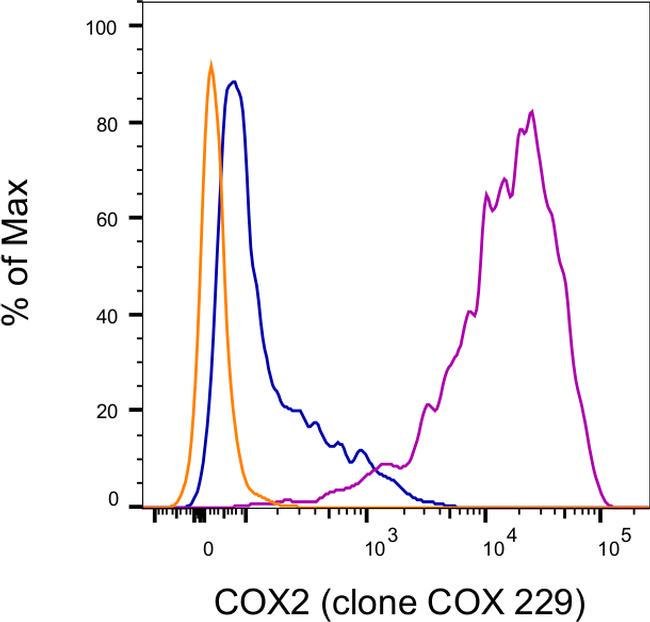
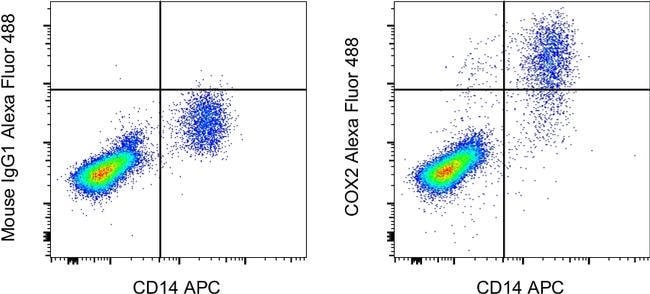
Description: This COX 229 monoclonal antibody recognizes human COX2 also known as PTGS2. This antibody has been reported to cross-react with the mouse and rat COX2. For optimal performance we recommend using this antibody with the Foxp3 / Transcription Factor Staining Buffer Set and protocol. Applications Reported: This COX 229 antibody has been reported for use in intracellular staining followed by flow cytometric analysis. Applications Tested: This COX 229 antibody has been tested by intracellular staining followed by flow cytometric analysis of stimulated normal human peripheral blood cells using the Foxp3/Transcription Factor Staining Buffer Set (Product # 00-5523-00) and protocol. Please refer to Staining Intracellular Antigens for Flow Cytometry, Protocol B: One step protocol for intracellular (nuclear) proteins located at www.thermofisher.com/flowprotocols. This may be used at less than or equal to 0.25 μg per test. A test is defined as the amount (μg) of antibody that will stain a cell sample in a final volume of 100 μL. Cell number should be determined empirically but can range from 10^5 to 10^8 cells/test. It is recommended that the antibody be carefully titrated for optimal performance in the assay of interest. Excitation: 488 nm; Emission: 519 nm; Laser: Blue Laser
COX2 converts arachidonate to prostaglandin H2 (PGH2), a committed step in prostanoid synthesis, including production of inflammatory prostaglandins. The conversion of arachidonate to prostaglandin H2 is a 2 step reaction: a cyclooxygenase (COX) reaction which converts arachidonate to prostaglandin G2 (PGG2) and a peroxidase reaction in which PGG2 is reduced to prostaglandin H2 (PGH2). It is constitutively expressed in some tissues in physiological conditions, such as the endothelium, kidney and brain, and is up-regulated under pathological conditions, such as in cancer and inflammation (in contrast to the iso-enzyme PTGS1, which is expressed ubiquitously). Up-regulation of COX2 is also associated with increased cell adhesion, phenotypic changes, resistance to apoptosis and tumor angiogenesis. In cancer cells, COX2 is a key step in the production of prostaglandin E2 (PGE2), which plays important roles in modulating motility, proliferation and resistance to apoptosis. COX2 is naturally inhibited by calcitriol (the active form of Vitamin D). Glucocorticoids chronically trans-repress PTGS2 gene activity in vivo in part by interfering with transcription initiation and elongation. COX2 is a target of NSAID such as aspirin, which can reduce pain and swelling from inflammation driven by COX2.Spécification
| COX2 | |
| Flow Cytometry | |
| Alexa Fluor 488 | |
| Mouse | |
| Human | |
| 5743 | |
| Synthetic peptide from human COX2 | |
| Primary | |
| Antibody |
| COX 229 | |
| Monoclonal | |
| Liquid | |
| RUO | |
| P35354 | |
| PTGS2 | |
| IgG1 κ | |
| 4° C, store in dark, DO NOT FREEZE! | |
| PTGS2 |
Vous avez repéré une opportunité d'amélioration ?Partager une correction de contenu
Correction du contenu d'un produit
Veuillez fournir vos retours sur le contenu du produit en remplissant le formulaire ci-dessous.
Nom du produit