missing translation for 'onlineSavingsMsg'
Learn More
Learn More
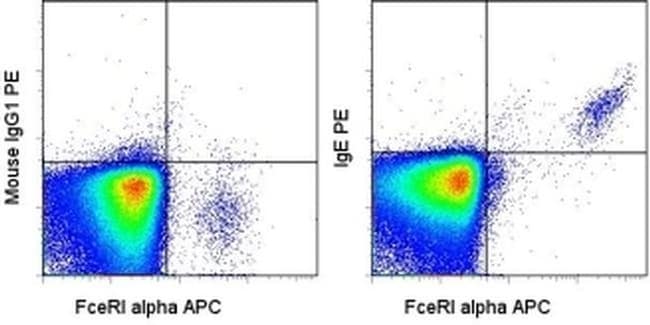
Invitrogen™ IgE Monoclonal Antibody (Ige21), PE, eBioscience™, Invitrogen™

Mouse Monoclonal Antibody
Marque: Invitrogen™ 12-6986-42
Les retours ne sont pas autorisés pour ce produit.
Afficher la politique du retour.
Description
Description: The monoclonal antibody IgE21 recognizes the immunoglobulin E class of antibodies. The natural levels of IgE in the serum are quite low, comprising only a small portion of the total immunoglobulin. IgE plays a role in allergy responses by binding to mast cells and basophils through the Fc epsilon receptor I which results in the release of histamine and other molecules. The IgE is produced by terminally differentiated plasma B cells and basophils. Like all immunoglobulins, IgE is expressed as a soluble molecule as well as a membrane bound form. IgE21 recognizes both forms. Applications Reported: This Ige21 antibody has been reported for use in flow cytometric analysis. Applications Tested: This Ige21 antibody has been pre-titrated and tested by flow cytometric analysis of human peripheral blood cells. This can be used at 5 μL (0.125 μg) per test. A test is defined as the amount (μg) of antibody that will stain a cell sample in a final volume of 100 μL. Cell number should be determined empirically but can range from 10^5 to 10^8 cells/test. Excitation: 488-561 nm; Emission: 578 nm; Laser: Blue Laser, Green Laser, Yellow-Green Laser. Filtration: 0.2 μm post-manufacturing filtered.
IgE is one of the five classes of immunoglobulins found in mammals, characterized by its monomeric structure consisting of two heavy (epsilon) chains with four Ig-like constant domains and two light chains. Although IgE comprises only a small portion of the total immunoglobulin in serum, it plays a crucial role in type I hypersensitivity reactions, such as hay fever, asthma, hives, and anaphylactic shock. IgE is produced by terminally differentiated plasma B cells and basophils. It binds to Fc epsilon receptors on mast cells and basophils, leading to the release of histamine and other molecules that promote allergic responses. Crosslinking of IgE bound to these receptors induces degranulation of mast cells and basophils, resulting in allergic manifestations. In addition to its role in allergic responses, IgE is functionally important for immunity against parasites, highlighting its dual role in both protective and pathological immune processes.
Spécification
| Human IgE | |
| Monoclonal | |
| 5 μL/Test | |
| PBS with BSA and 0.09% sodium azide; pH 7.2 | |
| P01854 | |
| IGHE | |
| Affinity chromatography | |
| RUO | |
| 3497 | |
| 4°C, store in dark, DO NOT FREEZE! | |
| Liquid |
| Flow Cytometry | |
| Ige21 | |
| PE | |
| IGHE | |
| HCAK1; IgA1; IgG3; IGHA1; IGHA2; IGHG1; IGHG2; IGHG3; IGHG4; IGKC; IGKCD; IGLC; IGLC1; Immunoglobulin E; immunoglobulin heavy constant alpha 1; immunoglobulin heavy constant alpha 2 (A2m marker); immunoglobulin heavy constant gamma 1 (G1m marker); immunoglobulin heavy constant gamma 2 (G2m marker); immunoglobulin heavy constant gamma 3 (G3m marker); immunoglobulin heavy constant gamma 4 (G4m marker); immunoglobulin kappa constant; immunoglobulin lambda constant 1; ImmunoglobulinE; Km | |
| Mouse | |
| 100 Tests | |
| Primary | |
| Human | |
| Antibody | |
| IgG1 κ |
Correction du contenu d'un produit
Veuillez fournir vos retours sur le contenu du produit en remplissant le formulaire ci-dessous.
Nom du produit
For Research Use Only.
Vous avez repéré une opportunité d'amélioration ?Partager une correction de contenu