missing translation for 'onlineSavingsMsg'
Learn More
Learn More
Invitrogen™ TCR gamma/delta Monoclonal Antibody (B1.1), Functional Grade, eBioscience™, Invitrogen™

Mouse Monoclonal Antibody
Marque: Invitrogen™ 16-9959-81
Les retours ne sont pas autorisés pour ce produit.
Afficher la politique du retour.
Description
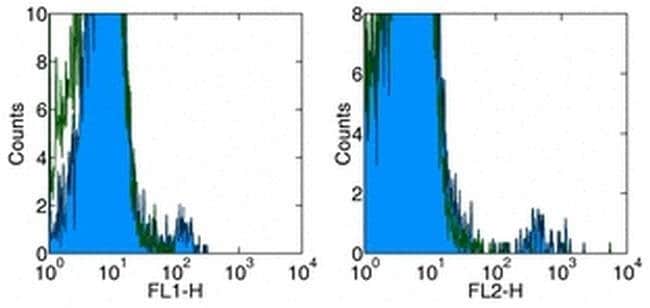
The B1.1 MAb reacts with the human gamma delta TCR complex. The gamma delta TCR is expressed by a small subset of T cells in the thymus, peripheral lymphoid tissues, intestinal epithelium, and epidermis. The exact specificity, ligand and function of gamma delta TCR-bearing T cells are not yet fully understood; it is suggested that these cells recognize bacterial ligands and some tumor cells in the context of MHC class I-like gene products and play a role in regulation of the immune response and during bacterial infection. This monoclonal can be used as a phenotypic marker for gamma delta TCR-expressing T cells. Applications Reported: This B1.1 antibody has been reported for use in flow cytometric analysis. Applications Tested: The B1.1 antibody has been tested by flow cytometric analysis of normal human peripheral blood cells. This can be used at less than or equal to 1 μg per test. A test is defined as the amount (μg) of antibody that will stain a cell sample in a final volume of 100 μL. Cell number should be determined empirically but can range from 10^5 to 10^8 cells/test. It is recommended that the antibody be carefully titrated for optimal performance in the assay of interest. Storage and handling: Use in a sterile environment. Filtration: 0.2 μm post-manufacturing filtered. Purity: Greater than 90%, as determined by SDS-PAGE. Endotoxin Level: Less than 0.001 ng/ μg antibody, as determined by LAL assay. Aggregation: Less than 10%, as determined by HPLC.
TCR gamma/delta (T-cell receptor gamma/delta) are specialized T-cells in the immune system. The ability of T cell receptors (TCR) to discriminate foreign from self-peptides presented by major histocompatibility complex (MHC) class II molecules is essential for an effective adaptive immune response. TCR recognition of self-peptides has been linked to autoimmune disease. Mutant self-peptides have been associated with tumors. Engagement of TCRs by a family of bacterial toxins know as superantigens has been responsible for toxic shock syndrome. Autoantibodies to V beta segments of T cell receptors have been isolated from patients with rheumatoid arthritis (RA) and systemic lupus erythematosus (SLE). The autoantibodies block TH1-mediated inflammatory auto-destructive reactions and are believed to be a method by which the immune system compensates for disease. Most human T cells express the TCR alpha-beta and either CD4 or CD8 molecule (single positive, SP). However, a small number of T cells lack both CD4 and CD8 (double negative, DN). Increased percentages of alpha-beta DN T cells have been identified in some autoimmune and immunodeficiency disorders. Gamma-delta T cells are primarily found within the epithelium. They show less TCR diversity and recognize antigens differently than alpha-beta T cells. Subsets of gamma-delta T cells have shown antitumor and immunoregulatory activity.
Spécification
| TCR gamma/delta | |
| Monoclonal | |
| 1 mg/mL | |
| PBS with no preservative; pH 7.2 | |
| 0 | |
| TRD, Trg | |
| Affinity Chromatography | |
| RUO | |
| 6964, 6965 | |
| 4°C | |
| Liquid |
| Flow Cytometry, Functional Assay | |
| B1.1 | |
| Functional Grade | |
| TRD | |
| RGD1311300; similar to T cell receptor V delta 6; T cell receptor gamma locus; T3/TCR complex; TCR delta gamma; TCR gamma/delta; TCR-CD3 complex; Tcrg; Trg; Trg@ | |
| Mouse | |
| 50 μg | |
| Primary | |
| Human | |
| Antibody | |
| IgG1 κ |
Correction du contenu d'un produit
Veuillez fournir vos retours sur le contenu du produit en remplissant le formulaire ci-dessous.
Nom du produit
Vous avez repéré une opportunité d'amélioration ?Partager une correction de contenu